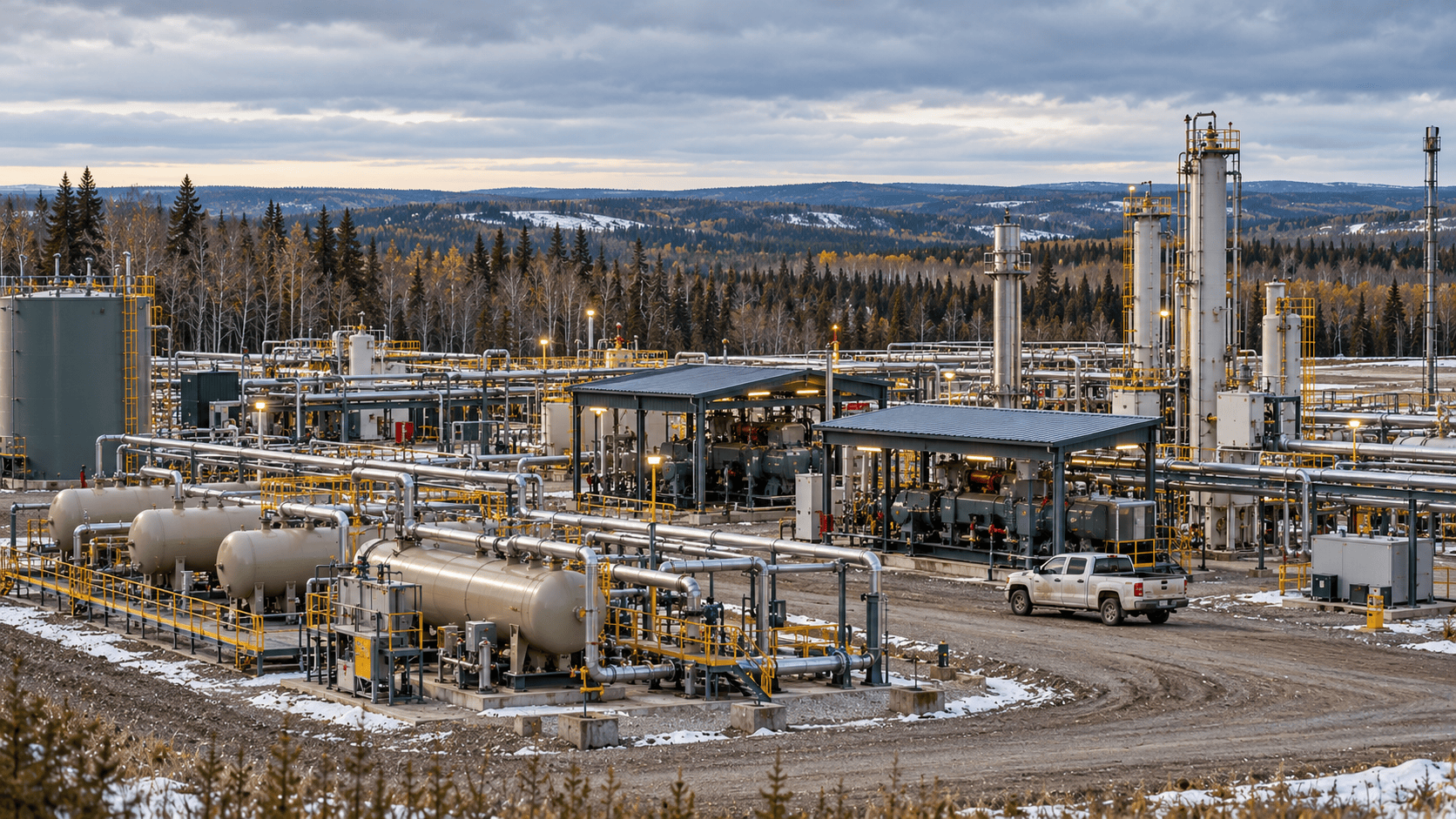
Natural gas does not usually travel directly from an Alberta wellhead to a home, factory or major transmission pipeline.
Before it can reach most customers, the gas must be processed to remove unwanted substances, manage moisture and, in many cases, recover valuable natural gas liquids.
This work takes place at hundreds of gas processing facilities throughout Alberta.
Some plants are relatively small installations serving conventional natural gas fields. Others are major industrial facilities containing large compressors, processing towers, refrigeration systems, sulphur recovery equipment and extensive pipeline connections.
These facilities are particularly important in producing regions such as Grande Prairie, Fox Creek, Edson, Whitecourt, Rocky Mountain House, Sundre and Central Alberta.
Alberta’s natural gas processing industry includes specialized midstream businesses such as Keyera, Pembina Gas Infrastructure, AltaGas, CSV Midstream and Tidewater Midstream.
It also includes producers that own and operate their own facilities.
Tourmaline Oil, Peyto Exploration, Birchcliff Energy, Advantage Energy and several other producers have invested heavily in gas processing infrastructure.
This distinction matters because a company that owns and operates a processing plant may have different responsibilities from a company that simply delivers raw gas to the facility.
Some gas plants serve only one producer. Others process gas from numerous companies under commercial agreements.
Alberta also has specialized facilities dedicated to recovering natural gas liquids from gas streams that have already undergone other processing.
This guide examines 16 companies involved in Alberta natural gas processing, including independent midstream operators, producer owned gas plant businesses and specialized natural gas liquids recovery operators.
The companies are organized by their actual operations rather than ranked by revenue or processing capacity.
What Does a Natural Gas Processing Plant Do?
Raw natural gas produced from underground formations is not necessarily ready to enter a transmission pipeline.
Depending on the reservoir, the gas may contain water vapour, hydrogen sulphide, carbon dioxide, condensate and other hydrocarbons.
Some of these components must be removed to meet pipeline specifications.
Others can be separated and sold as valuable products.
A natural gas processing plant performs the necessary treatment and separation.
The exact process depends on the composition of the incoming gas.
For example, gas containing significant hydrogen sulphide may require amine treatment and additional sulphur handling.
A liquids rich gas stream may require refrigeration or deeper hydrocarbon extraction to recover natural gas liquids.
Dry natural gas may require less extensive processing.
Different plants therefore have different equipment, operating capabilities and commercial arrangements.
The most important services include gas compression, dehydration, sour gas treatment, liquids extraction, condensate stabilization and sulphur recovery.
Independent Natural Gas Processing Companies in Alberta
Independent midstream companies are a major part of Alberta’s gas processing industry.
These businesses generally own or operate infrastructure that gathers, treats, processes and transports gas produced by other companies.
Their revenue often comes from processing fees, transportation agreements and other commercial arrangements.
1. Keyera
Keyera is a Calgary headquartered energy infrastructure company and one of Alberta’s established natural gas processing operators.
The company owns interests in numerous gas processing plants throughout the province.
Its facilities are concentrated in producing regions across western and northwestern Alberta.
Keyera’s gas processing business includes sour gas treatment, compression, dehydration, natural gas liquids extraction and condensate handling.
Keyera’s Alberta Gas Processing Facilities
Important Keyera facilities include the Simonette, Wapiti, Pipestone, Rimbey, Strachan and Brazeau River gas plants.
These plants serve different producing areas and process gas with different characteristics.
The Simonette Gas Plant operates in the Montney and Duvernay development region.
It provides sour gas processing, gas sweetening, liquids recovery and condensate stabilization.
The Wapiti Gas Plant also handles sour natural gas and associated liquids.
Its equipment includes acid gas injection facilities.
Keyera’s Pipestone Gas Plant supports liquids rich Montney development.
The plant provides sour gas processing and condensate handling.
In Central Alberta, the Rimbey Gas Plant performs several processing functions, including sour gas treatment, natural gas liquids recovery and sulphur recovery.
The Strachan Gas Plant serves producing areas in west central Alberta and is connected with other Keyera processing facilities.
Integrated Processing and Liquids Infrastructure
One of Keyera’s strengths is the connection between its gas processing facilities and its liquids transportation infrastructure.
After valuable liquids are recovered from raw gas, they need to be moved to customers or facilities where they can be separated into individual products.
Keyera operates gathering systems, liquids pipelines and processing facilities that support this movement.
In June 2026, Keyera completed the acquisition of the remaining ownership interest in the KAPS liquids pipeline.
Keyera now owns the entire KAPS system.
The pipeline connects producing areas in the Montney and Duvernay with downstream liquids infrastructure.
KAPS itself is a transportation system rather than a natural gas processing plant, but it strengthens the market access available to liquids recovered at upstream facilities.
Keyera is an important example of a company providing integrated natural gas processing and liquids transportation services.
2. Pembina Pipeline and Pembina Gas Infrastructure
Pembina Pipeline Corporation is a Calgary headquartered energy infrastructure business with extensive natural gas processing assets.
Much of its field gas processing business operates through Pembina Gas Infrastructure, commonly called PGI.
PGI is one of the largest gas processing platforms in Western Canada.
Its assets include gas plants, gathering pipelines, compression stations and natural gas liquids recovery equipment.
Pembina Gas Infrastructure Ownership
PGI was established in 2022 when Pembina combined its field gas processing assets with infrastructure contributed through a partnership involving KKR.
The ownership structure subsequently changed.
In 2026, funds managed by Apollo acquired KKR’s ownership interest.
Pembina retains a 60% interest in PGI and continues to manage and operate its facilities.
Apollo managed funds own the remaining 40%.
This change is important because older industry descriptions may still identify KKR as the current minority investor.
Major Alberta Gas Plants
PGI’s gas processing network includes the Cutbank Complex near Grande Prairie.
The complex contains several processing facilities associated with Cutbank and Musreau.
These plants handle sweet natural gas and recover associated liquids.
PGI also has important facilities in the Kaybob and Fox Creek regions.
Its Duvernay Complex and Kaybob processing plants support natural gas and condensate development across west central Alberta.
Some of these facilities handle sour gas and require more extensive processing than conventional sweet gas plants.
A Large Processing Network
PGI’s operations extend across Alberta and northeastern British Columbia.
Its Alberta assets are particularly important in the Montney, Duvernay and Deep Basin.
The company provides processing services to producers that may not own sufficient facilities of their own.
It also develops infrastructure under commercial agreements with producing companies.
These arrangements can include processing capacity commitments, gathering systems and facilities funded by PGI but operated by a producing customer.
For companies looking for large natural gas processing and gathering services in Alberta, PGI is one of the major organizations in the industry.
3. AltaGas
AltaGas is a Calgary headquartered energy infrastructure company with substantial natural gas processing and liquids operations in Alberta.
The company also operates energy infrastructure in British Columbia and the United States.
Its Alberta assets include gas processing facilities, liquids extraction plants, fractionation equipment and natural gas storage.
Harmattan Gas Processing Complex
Harmattan is one of AltaGas’s most important Alberta facilities.
The complex is located near Sundre, north of Calgary.
It provides natural gas processing for numerous producers operating in the surrounding region.
Harmattan handles both gas treatment and liquids recovery.
The facility can separate recovered natural gas liquids into products such as ethane, propane, butane and condensate.
It also provides terminalling and associated services.
Harmattan has extensive processing and liquids handling equipment, making it more than a simple field gas dehydration facility.
Pipestone Natural Gas Processing
AltaGas expanded its position in the Alberta Montney by acquiring Pipestone infrastructure from Tidewater Midstream in December 2023.
The acquisition included Pipestone I, the planned second processing phase, gathering pipelines and associated facilities.
AltaGas subsequently developed Pipestone II.
The facility began commercial operations in December 2025.
Pipestone II provides additional sour natural gas processing and liquids handling capacity.
This infrastructure is important because liquids rich Montney wells can produce significant quantities of condensate alongside natural gas.
The producer must have facilities capable of handling both streams.
Gordondale Gas Plant
AltaGas also owns the Gordondale Gas Plant in northwestern Alberta.
Birchcliff Energy operates this facility and processes its production through the plant.
This is an important example of the distinction between ownership and operatorship.
AltaGas owns the facility, while Birchcliff is responsible for operating it under the applicable arrangement.
AltaGas is a major gas processing company because its operations combine field gathering, processing, liquids handling and access to downstream markets.
4. CSV Midstream Solutions
CSV Midstream Solutions is a Calgary based company specializing in natural gas processing infrastructure.
The business develops, constructs and operates gas plants in northwestern Alberta.
Its main operating areas are associated with Grande Prairie, Grande Cache and surrounding Montney development.
CSV has grown through a combination of new construction and acquisitions.
Its current infrastructure network includes several gas plants with different processing capabilities.
Albright Gas Processing Facility
Albright is one of CSV’s most significant developments.
The facility is located in northern Alberta near Grande Prairie.
It began operating in November 2025.
Albright was designed to process sour natural gas and recover valuable liquids.
The plant also includes sulphur recovery equipment.
CSV describes Albright as Alberta’s first newly constructed sour gas processing plant with sulphur recovery in more than three decades.
The facility has a designed sour gas processing capacity of approximately 150 million cubic feet per day.
Albright is intended to serve multiple producers.
This makes it different from a gas plant dedicated entirely to one producing company’s wells.
Karr and Simonette
CSV also operates the Karr Gas Plant in northwestern Alberta.
The facility processes sour gas and handles significant volumes of condensate and other produced liquids.
Karr includes compression, refrigeration and gas treatment systems.
CSV’s Simonette facility serves another part of the Montney development region.
It provides natural gas processing, dehydration, refrigeration, compression and condensate stabilization.
Valhalla and Resthaven
CSV’s Valhalla facility provides sour natural gas processing.
It includes acid gas handling and liquids recovery equipment.
The company’s Resthaven facility is located northeast of Grande Cache.
This facility provides natural gas processing services under an established commercial arrangement.
Tourmaline has a contract operating role at the CSV Resthaven facility.
There are other gas plants in Western Canada using the Resthaven name, so facility ownership and location should be confirmed when identifying a specific asset.
Proposed Fort Saskatchewan Development
In June 2026, CSV announced plans for a natural gas liquids fractionation facility in Fort Saskatchewan.
The proposed development would separate mixed natural gas liquids into saleable products.
The project is still subject to investment decisions and regulatory requirements.
It should not be described as an operating facility.
CSV is particularly relevant to producers requiring sour gas processing and associated liquids infrastructure in northwestern Alberta.
5. Tidewater Midstream
Tidewater Midstream and Infrastructure is a Calgary based energy company operating natural gas processing, liquids handling and other infrastructure.
Its Alberta gas processing business is now more concentrated around west central Alberta than it was several years ago.
This reflects asset sales and changes in the company’s operating portfolio.
Brazeau River Complex
The Brazeau River Complex is one of Tidewater’s main gas processing assets.
The facility is located in Alberta’s Deep Basin.
It provides natural gas processing, liquids extraction, fractionation, storage and terminalling.
The complex can handle gas produced from surrounding petroleum fields and recover valuable hydrocarbons.
It also includes underground natural gas storage.
In January 2026, Tidewater announced new and renewed gas handling and natural gas liquids agreements at the facility.
These commercial arrangements support continued processing activity.
Ram River Gas Plant
Tidewater also owns a substantial interest in the Ram River Gas Plant in west central Alberta.
The facility is designed for sour gas processing and includes sulphur handling infrastructure.
However, Ram River’s main gas processing operation was temporarily suspended in January 2025.
Tidewater’s second quarter 2026 reporting stated that the plant remained offline.
Some associated sulphur handling activity had resumed, but this should not be confused with full natural gas processing operations restarting.
The company intends to restart processing when producer gas flow supports doing so.
Tidewater’s Former Pipestone Facilities
Tidewater previously owned the Pipestone gas processing facilities in northwestern Alberta.
It sold those assets to AltaGas in December 2023.
Tidewater also sold its Sylvan Lake Gas Processing Facility to Parallax Energy in October 2025.
Older descriptions of Tidewater’s gas processing portfolio may still include these former assets.
For an accurate current company list, those ownership changes must be recognized.
Tidewater remains an established Alberta midstream company, with the Brazeau River Complex an important operating asset.
6. NorthRiver Midstream
NorthRiver Midstream is a Canadian natural gas gathering and processing company with operations in Alberta and British Columbia.
The company operates a network of facilities concentrated in the Montney producing region.
Its main business involves collecting raw gas from producers and providing processing and transportation services.
Northwestern Alberta Facilities
NorthRiver’s Alberta asset network includes the Gordondale East and Gordondale West facilities.
These operations are located within the broader Peace River and Montney producing region.
The company also owns natural gas processing infrastructure around Pouce Coupe.
Its facilities support producers requiring gas processing and access to transportation systems.
Gas Gathering Infrastructure
NorthRiver also operates the Pipestone gas gathering system.
This system connects producing wells and infrastructure in northwestern Alberta.
Gathering pipelines are important because an individual well may be located several kilometres from the nearest processing facility.
Raw gas must be transported to a suitable plant before entering certain sales pipelines.
The capacity and configuration of the gathering system can affect how quickly additional wells can be brought into production.
A Western Canadian Processing Business
NorthRiver operates a broader processing network in northeastern British Columbia.
These include facilities in the Dawson Creek, Fort St. John and Fort Nelson regions.
Although those operations are outside Alberta, they are connected to the same broader Montney resource development.
For Alberta producers, NorthRiver is particularly relevant to gas gathering and processing in the northwestern part of the province.
7. Wolf Midstream
Wolf Midstream is a Calgary headquartered private energy infrastructure company backed by CPP Investments.
The company operates several types of energy infrastructure, including liquids pipelines, carbon dioxide transportation and natural gas liquids recovery systems.
Its natural gas liquids business is particularly relevant to Alberta’s processing industry.
NGL North System
Wolf’s NGL North System is designed to recover valuable hydrocarbons from natural gas and move the recovered liquids to downstream markets.
The network includes recovery facilities in northern Alberta, liquids pipelines and a separation complex near Fort Saskatchewan.
The system recovers products such as ethane, propane, butane and condensate.
This differs from a conventional field gas plant whose main purpose may be removing hydrogen sulphide or water from raw wellhead gas.
Wolf’s recovery facilities focus on extracting additional value from gas streams.
A Major 2026 Expansion
In September 2026, Wolf announced a final investment decision to proceed with another expansion of the NGL North System.
The company plans to add recovery equipment at its facilities near Mariana Lake and northwest of Fort McMurray.
It also plans to expand its downstream separation infrastructure in Sturgeon County.
The investment is expected to increase liquids recovery and separation capacity.
Wolf has stated that the required permits and approvals for the main expansion components are in place and that development activities are underway.
However, the additional facilities have different expected completion dates extending into 2027 and 2028.
Their future capacity should not be counted as current operating production.
Wolf is an important example of Alberta’s growing specialized natural gas liquids processing industry.
Alberta Gas Producers With Their Own Processing Plants
Not every natural gas processing plant belongs to an independent midstream company.
Some producers own and operate facilities specifically designed to process gas from their own wells.
These companies may also process third party gas, depending on capacity and commercial agreements.
Producer owned infrastructure can reduce dependence on outside processors and allow closer coordination between drilling and plant capacity.
8. Tourmaline Oil
Tourmaline Oil is a Calgary headquartered natural gas producer with extensive processing infrastructure in Alberta.
The company is particularly important in the Deep Basin.
Its natural gas wells are connected to a large network of gathering pipelines and processing facilities.
Alberta Deep Basin Gas Plants
Tourmaline’s Deep Basin operations extend across west central Alberta.
Its operating areas include producing regions around Edson, Whitecourt and the surrounding Foothills.
The company reports ownership interests in 23 natural gas plants in the Alberta Deep Basin.
Of those, 11 are identified as fully owned and operated by Tourmaline.
These facilities collectively support a substantial portion of the company’s gas production.
Some plants handle sweet natural gas.
Others provide more extensive treatment and liquids recovery.
Why Tourmaline Owns Processing Infrastructure
Tourmaline has emphasized controlling production and operating costs.
Owning gas plants can reduce dependence on third party processing arrangements.
It can also allow the company to coordinate drilling with available processing capacity.
This is particularly useful in areas where the company owns multiple producing zones and can drill additional wells near existing facilities.
However, owning infrastructure also creates responsibility for maintenance, turnarounds and eventual facility closure.
Tourmaline operates a large gas processing business as part of its broader natural gas production operations.
9. Peyto Exploration & Development
Peyto Exploration & Development is a Calgary headquartered natural gas producer specializing in Alberta’s Deep Basin.
The company is particularly associated with producing regions around Edson and Brazeau River.
Peyto has developed its business around maintaining control of its production infrastructure.
Peyto’s Gas Processing Network
Peyto operates a large group of natural gas processing plants.
Its infrastructure includes gathering pipelines, compressors and facilities that separate marketable gas from liquids and other components.
In its 2026 corporate information, Peyto identified operated natural gas processing capacity of approximately 1.5 billion cubic feet per day.
The facilities are concentrated within its established Deep Basin operating area.
Sundance and Brazeau
The Greater Sundance and Brazeau regions are important parts of Peyto’s business.
Its wells produce natural gas and associated liquids from multiple sandstone formations.
The company connects new wells to its existing infrastructure where possible.
This can improve the economics of development because the producer may not need to construct an entirely new gas plant for each group of wells.
Operating Efficiency
Peyto has emphasized the relationship between processing costs and natural gas production economics.
A low gas selling price can make operating costs particularly important.
Owning and controlling infrastructure gives Peyto greater ability to manage those costs.
However, processing capacity does not automatically mean the plants are operating at full capacity.
Actual throughput depends on available production and demand for processing services.
Peyto is an important company in Alberta gas processing because its production and plant operations are closely integrated.
10. Birchcliff Energy
Birchcliff Energy is a Calgary based natural gas and liquids producer focused on the Montney in northwestern Alberta.
Its principal producing areas are Pouce Coupe and Gordondale.
Birchcliff owns and operates substantial gas processing infrastructure.
Pouce Coupe Gas Plant
Birchcliff owns and operates the Pouce Coupe Gas Plant.
The facility handles production from the company’s surrounding Montney wells.
It has been expanded over time as Birchcliff’s production increased.
The plant provides gas processing and associated liquids handling.
Birchcliff has emphasized the benefits of controlling its own processing costs.
Gordondale Processing
Birchcliff also operates the Gordondale Gas Plant.
However, the plant is owned by AltaGas.
Birchcliff assumed operatorship in July 2024.
This distinction is important because ownership and operating responsibility can belong to different companies.
Birchcliff processes its Gordondale production through the facility.
The company’s broader operations also involve compression, gathering systems, water handling and associated infrastructure.
Birchcliff remains a significant natural gas processing operator within Alberta’s Montney development region.
11. Advantage Energy
Advantage Energy is a Calgary headquartered natural gas and liquids producer operating in northwestern Alberta.
Its major producing areas include Glacier, Progress, Valhalla and Wembley.
The company owns substantial processing infrastructure associated with these properties.
Glacier Gas Plant
Glacier is one of Advantage’s main producing areas.
The company operates a major gas processing facility there.
The plant is connected to surrounding Montney wells.
During the second quarter of 2026, Advantage completed a planned turnaround at Glacier.
This temporarily reduced production while maintenance was performed.
Gas plant turnarounds are important because processing facilities require periodic inspections, repairs and equipment replacement.
Progress Gas Plant
Advantage completed construction of the Progress Gas Plant during 2026.
The facility entered service before the planned Glacier turnaround.
It provides additional processing capacity for production associated with the Progress and Valhalla areas.
The new plant also improves the company’s ability to handle liquids rich natural gas.
Why the New Facility Matters
A producer may have productive wells but lack enough processing capacity to handle additional raw gas.
In that situation, drilling more wells may not immediately result in higher sales volumes.
The Progress plant gives Advantage additional flexibility.
It also creates ongoing work involving plant operations, compressors, instrumentation, pipelines and maintenance.
Advantage is a clear example of a producer investing in gas processing infrastructure to support growth from its own wells.
12. Paramount Resources
Paramount Resources is a Calgary headquartered oil and natural gas producer with operations in the Duvernay and Montney.
The company has invested heavily in production facilities at Willesden Green and other Alberta properties.
Alhambra Gas Plant
The Alhambra Plant is an important part of Paramount’s Willesden Green Duvernay development.
The facility handles raw natural gas and associated liquids from surrounding wells.
Paramount brought the second phase of Alhambra into service in June 2026.
The expansion doubled the plant’s designed raw gas handling capacity to approximately 100 million cubic feet per day.
It also expanded liquids handling capability.
Paramount reported that production from new Duvernay wells rapidly filled much of the additional available gas capacity.
Leafland Gas Plant
Paramount also operates the Leafland facility in the Willesden Green region.
The company has been developing infrastructure to connect the Leafland and Alhambra plants.
These connections allow the producer to improve how production is directed between facilities.
Paramount has also invested in compression and dehydration equipment.
Sinclair Gas Plant Development
The company is also constructing the proposed Sinclair Gas Plant west of Grande Prairie.
The facility is intended to process raw Montney natural gas production.
Paramount’s current development plan targets startup in 2027.
Sinclair represents sanctioned development work, but the proposed future processing capacity should not be described as currently operating.
Paramount illustrates how major gas processing projects are often developed in stages as additional producing wells become available.
13. Canlin Energy
Canlin Energy is a privately owned Calgary based natural gas producer with extensive processing infrastructure.
Its operations include conventional and unconventional natural gas fields across Alberta and British Columbia.
Canlin is unusual because it operates as both an upstream producer and a provider of midstream services.
Alberta Gas Processing Facilities
Canlin’s Alberta facilities include Ferrier, Wildcat Hills, Hanlan Robb and other gas processing plants.
The Ferrier Gas Plant is located near Rocky Mountain House.
It processes sweet natural gas and includes liquids recovery and fractionation equipment.
The Wildcat Hills Gas Plant is located west of Cochrane.
It processes sour gas using specialized treatment and dehydration systems.
Canlin also operates the Hanlan Robb Gas Plant southwest of Edson.
The facility provides sour gas processing, sulphur recovery and other treatment services.
Processing for Multiple Producers
Canlin offers gas processing and associated infrastructure services to other petroleum producers.
These include inlet separation, compression, sweet and sour gas treatment, hydrocarbon recovery, stabilization and sulphur handling.
The company also operates extensive pipeline infrastructure.
This makes Canlin more than a producer with one small dedicated gas plant.
Its facilities form part of the broader natural gas processing system serving conventional Alberta fields.
Canlin is particularly relevant to producers seeking processing arrangements in established Central and West Central Alberta gas regions.
14. Whitecap Resources
Whitecap Resources is a Calgary headquartered oil and natural gas producer with substantial operations in Alberta.
The company owns and operates several production facilities.
Some of these assets involve shared ownership with infrastructure companies.
Kaybob Processing Complex
Whitecap operates the Kaybob Complex in west central Alberta.
The facility handles natural gas and associated liquids from the company’s producing properties.
In December 2024, Pembina Gas Infrastructure acquired a 50% ownership interest in the Kaybob Complex.
Whitecap retained the remaining interest and continued as operator.
The facility remains associated with Whitecap’s production operations even though its ownership is shared.
Musreau Infrastructure
Whitecap also has infrastructure associated with its Musreau producing properties.
The company sold a 50% interest in its Musreau facility to Topaz Energy in 2024 while retaining operatorship.
This is another example of an upstream producer operating infrastructure partly owned by an outside investor.
Lator Development
Whitecap has also been developing new production infrastructure at Lator in the Montney.
The development includes gas compression, condensate handling and gathering facilities.
Pembina Gas Infrastructure is financing and owning specified infrastructure under commercial agreements.
Whitecap is responsible for the associated operating and development work.
The project is intended to support additional production from Whitecap’s Montney wells.
Whitecap’s business illustrates how gas producers can share infrastructure ownership with midstream companies while continuing to manage field operations.
15. Parallax Energy
Parallax Energy is a privately owned Calgary based oil and natural gas producer focused on the eastern Duvernay.
The company’s operations include the Joffre and Sylvan Lake regions.
Parallax owns production infrastructure associated with its light oil and natural gas development.
Sylvan Lake Gas Processing Facility
Parallax acquired the Sylvan Lake Gas Processing Facility from Tidewater Midstream in October 2025.
The transaction included the gas plant and associated gathering infrastructure.
The facility supports conventional and unconventional production in the surrounding area.
This acquisition gave Parallax greater direct control over local processing assets.
Why Producers Acquire Gas Plants
A producer may choose to purchase a gas processing facility for several reasons.
Owning the plant can provide access to processing capacity and reduce certain third party dependencies.
The company may also be able to improve operations or connect additional wells.
However, ownership creates responsibility for maintaining the facility and meeting applicable regulatory requirements.
Parallax’s Sylvan Lake acquisition is an example of a private producer bringing gas processing infrastructure into its own business.
The company is not a conventional independent midstream processor serving an extensive network of unrelated producers, but its facility ownership makes it part of Alberta’s gas processing industry.
16. Shell Canada
Shell is a major international energy company with expanded natural gas processing interests in Alberta following its acquisition of ARC Resources.
The transaction was completed on September 2, 2026.
ARC had previously operated a significant network of natural gas and liquids production infrastructure.
The former ARC business is now part of the Shell Group.
Kakwa Gas Processing Infrastructure
Kakwa is one of the important Alberta producing areas associated with the former ARC business.
The region is located south of Grande Prairie.
Its wells produce natural gas, condensate and other liquids from the Montney.
ARC had invested in gathering and processing infrastructure to support the development.
In July 2025, ARC completed an additional acquisition of Montney assets at Kakwa.
The acquired properties included ownership of natural gas processing facilities and related liquids infrastructure.
Those assets subsequently became part of Shell through the ARC acquisition.
Why Ownership Matters
Shell’s acquisition of ARC changed the corporate ownership of a major Alberta natural gas production and processing business.
ARC remains a recognizable operating name, but it is no longer an independent public company.
When researching current plant ownership, the former ARC assets should be considered within the Shell organization.
The processing plants continue to support Montney production, but the ownership group has changed.
Shell’s expanded presence is important to Alberta because it combines substantial natural gas resources with existing processing and liquids handling infrastructure.
The Difference Between Gas Processing, Gas Gathering and NGL Fractionation
Several different activities are often grouped together under the term natural gas processing.
They are closely connected but not identical.
Natural Gas Gathering
Gas gathering involves moving raw natural gas from producing wells to a processing facility.
Gathering systems generally consist of pipelines, valves, compressors and associated equipment.
A gathering company may own pipelines without operating the plant that processes the gas.
Natural Gas Processing
Gas processing involves treating and separating components from natural gas.
The objective can include removing water, hydrogen sulphide or carbon dioxide and recovering saleable liquids.
Different gas plants have different capabilities.
A facility designed for sweet gas may not be able to process sour gas without additional treatment equipment.
Natural Gas Liquids Extraction
Natural gas liquids extraction removes selected hydrocarbons from the gas stream.
These liquids can include ethane, propane, butane and heavier hydrocarbons.
Some extraction occurs at field gas plants.
Other specialized recovery facilities process gas that has already undergone earlier treatment.
Wolf Midstream’s NGL North system is an example of specialized liquids recovery infrastructure.
Natural Gas Liquids Fractionation
Fractionation separates a mixed natural gas liquids stream into individual products.
For example, a mixed stream may be separated into ethane, propane, butane and condensate.
Fractionation often takes place at downstream facilities connected to liquids pipelines.
It is not the same as removing hydrogen sulphide or dehydrating raw natural gas at a field plant.
Natural Gas Storage
Some facilities store natural gas underground.
Storage allows gas to be injected when market conditions are favourable and withdrawn when required.
Tidewater’s Brazeau River Complex includes natural gas storage.
AltaGas also operates natural gas storage infrastructure associated with its Alberta midstream business.
Storage is related to gas transportation and marketing but should not be confused with processing capacity.
Natural Gas Processing Companies by Alberta Region
Alberta’s gas processing industry is concentrated around major producing regions.
The location of the facilities reflects the geological formations being developed and the pipelines available to transport production.
Gas Processing Companies in Grande Prairie
Grande Prairie is one of Alberta’s most important natural gas processing centres.
The surrounding Montney development produces significant volumes of natural gas, condensate and other liquids.
Important companies serving the region include Keyera, Pembina Gas Infrastructure, AltaGas, CSV Midstream and NorthRiver.
Birchcliff, Advantage, Whitecap, Paramount and Shell also have substantial producer operated infrastructure associated with northwestern Alberta development.
Many of these plants require compressors, refrigeration systems and liquids stabilization equipment.
Some also process sour gas.
The Grande Prairie region is particularly important for new gas plant construction and expansion.
Gas Processing Companies Near Fox Creek
Fox Creek and the surrounding Kaybob region contain important Duvernay natural gas and liquids production.
Pembina Gas Infrastructure operates major facilities in this area.
Keyera also has processing assets serving the broader Duvernay and Montney regions.
Whitecap operates the Kaybob Complex under its shared ownership arrangement.
The region has significant demand for sour gas processing, liquids handling and gathering infrastructure.
Gas Processing Companies Near Edson and Whitecourt
Edson and Whitecourt are important centres for Deep Basin natural gas production.
Tourmaline, Peyto and Canlin operate infrastructure serving these areas.
Tidewater and Keyera also have processing assets in the broader west central Alberta region.
The area contains conventional gas plants as well as facilities serving newer horizontal wells.
Ongoing maintenance and facility optimization remain important because some processing infrastructure has been operating for many years.
Gas Processing Companies Near Rocky Mountain House
Rocky Mountain House and surrounding communities contain established conventional natural gas production.
Canlin operates the Ferrier Gas Plant northwest of Rocky Mountain House.
Keyera also has facilities serving Central Alberta.
The region’s gas processing infrastructure includes compression, liquids recovery and other systems associated with mature producing fields.
Gas Processing Companies Near Sundre
Sundre is particularly important because of AltaGas’s Harmattan Complex.
The facility provides natural gas processing and natural gas liquids services to numerous producers.
Its location connects it to established petroleum fields throughout the surrounding region.
Natural Gas Liquids Processing Near Fort Saskatchewan
Fort Saskatchewan and Sturgeon County are important locations for downstream natural gas liquids infrastructure.
Facilities in this region receive liquids recovered from natural gas produced elsewhere in Alberta.
Wolf Midstream operates its feedstock separation infrastructure in Sturgeon County.
Keyera and other companies also have substantial downstream liquids operations in the broader region.
This infrastructure is important because natural gas processing does not end when raw gas leaves the field plant.
Recovered liquids still need transportation, storage, separation and delivery to customers.
How Natural Gas Processing Plants Work
A modern Alberta gas processing facility may contain several stages of equipment.
Not every plant uses all these processes.
The configuration depends on the gas being processed and the products the facility is designed to recover.
Inlet Separation
Raw natural gas first enters equipment designed to separate free liquids and other materials.
These liquids may include water and condensate.
Removing free liquids helps protect downstream equipment and allows the different streams to be handled appropriately.
Natural Gas Compression
Compressors increase gas pressure.
They are used to move gas through gathering systems and processing equipment.
Compression is also required when gas must enter a transportation pipeline at a specified pressure.
Compressor equipment requires regular maintenance because it operates under demanding mechanical conditions.
Gas Dehydration
Natural gas can contain water vapour.
Excess moisture can create problems in pipelines and processing equipment.
Under suitable conditions, water can contribute to corrosion or the formation of hydrates.
Gas dehydration systems remove moisture to meet operating requirements.
Sour Gas Treatment
Sour natural gas contains hydrogen sulphide.
Processing facilities use specialized equipment to remove or manage acid gases.
Amine treatment is one common method.
The process requires careful control and appropriate safety systems.
Gas containing significant hydrogen sulphide presents additional hazards and must be handled using suitable equipment.
Sulphur Recovery
Some sour gas plants recover sulphur from hydrogen sulphide removed during processing.
The resulting sulphur can be handled as a commercial product.
Large sulphur recovery facilities require specialized equipment, technical personnel and operating procedures.
CSV’s Albright plant and Canlin’s Hanlan Robb facility are examples of Alberta gas plants with sulphur recovery capabilities.
Refrigeration and Liquids Extraction
Cooling the natural gas can cause heavier hydrocarbons to condense.
The resulting liquids can then be separated and recovered.
More advanced extraction systems can recover additional hydrocarbon components depending on the plant design.
Liquids recovery can be an important source of value for gas processing operations.
Condensate Stabilization
Condensate recovered from raw gas may require treatment before storage or transportation.
Stabilization helps manage the volatility of the liquid stream.
The stabilized product can then be directed to suitable storage or transportation systems.
Sales Gas Delivery
After processing, marketable natural gas is delivered into an appropriate pipeline.
The gas must satisfy the receiving pipeline’s specifications.
The requirements can include limits relating to moisture, heating value and certain unwanted components.
What Is the Difference Between Sweet Gas and Sour Gas Processing?
Sweet natural gas contains little or no hydrogen sulphide.
Sour natural gas contains hydrogen sulphide and may require additional treatment.
This difference is especially important when selecting a processing facility.
A plant designed for sweet gas may not have the equipment needed to handle sour production.
Sour gas processing can require amine systems, acid gas injection, sulphur recovery and specialized safety equipment.
Alberta has a long history of sour gas production.
Facilities around Fox Creek, Grande Prairie, Edson and other regions have developed specialized capabilities for processing it.
Producers must confirm that a plant is appropriate for the composition of their raw gas.
Which Alberta Gas Processing Companies Are Expanding in 2026?
Several recent developments illustrate how Alberta’s gas processing industry is changing.
AltaGas brought Pipestone II into commercial operation in December 2025.
CSV Midstream began operating its Albright sour gas facility in November 2025.
Advantage Energy completed the Progress Gas Plant in 2026.
Paramount brought the second phase of Alhambra into service in June 2026.
Wolf Midstream announced a further expansion of its northern Alberta liquids recovery system in September.
Other companies are developing or evaluating additional infrastructure.
However, the status of each project is different.
Some facilities are already operating.
Others are under construction.
Some proposed developments still require regulatory approvals or final investment decisions.
For oilfield contractors, these distinctions matter because an operating plant creates different service requirements from a project that is still being evaluated.
What Services Do Natural Gas Processing Companies Hire?
Gas processing plants require a broad range of specialized technical services.
Some work takes place during construction.
Other services are needed continuously throughout the operating life of the facility.
Gas Compression Services
Gas processing facilities depend on compressor equipment.
Contractors may provide installation, maintenance, repairs and equipment upgrades.
Compressors are used throughout gathering and processing systems.
Mechanical Contractors
Gas plants contain pumps, vessels, exchangers, valves and extensive piping systems.
Mechanical contractors perform installation, maintenance and repair work.
Major turnarounds can require additional skilled workers and specialized equipment.
Instrumentation and Electrical Companies
Modern gas plants use automated control systems.
Instrumentation technicians maintain the equipment used to measure pressure, temperature, levels and flow.
Electrical contractors support motors, power distribution and other plant systems.
Welding and Fabrication Companies
Gas processing infrastructure frequently requires specialized fabrication.
Contractors may manufacture pipe spools, equipment supports and other components.
Welding procedures and inspection requirements depend on the equipment and service conditions.
Industrial Insulation Companies
Processing equipment may require insulation to maintain temperatures, protect personnel or reduce energy losses.
Insulation work is common during construction and maintenance.
Pipeline Construction Companies
New wells and plants require gathering pipelines.
Existing systems may also need expansion or replacement.
Pipeline contractors perform construction, testing and related work.
Industrial Cleaning Companies
Gas plants require cleaning during maintenance and certain turnaround operations.
Specialized contractors can provide equipment for cleaning vessels, piping and other systems.
The methods used depend on the materials and operating conditions.
Environmental and Waste Management Companies
Processing operations generate waste streams requiring appropriate handling.
Environmental contractors provide waste management, spill response, monitoring and other services.
Gas plants also have regulatory obligations associated with emissions and environmental protection.
How to Choose a Natural Gas Processing Company in Alberta
For producers seeking processing capacity, selecting a facility is a major commercial and technical decision.
The nearest gas plant is not necessarily the most suitable option.
Confirm Gas Composition
The first consideration is whether the plant can process the intended gas stream.
The producer should understand hydrogen sulphide concentrations, liquids content and other relevant characteristics.
The plant must have the equipment needed for those conditions.
Review Available Processing Capacity
A plant may have substantial licensed capacity but limited available commercial capacity.
Some capacity may already be contracted.
Other limitations can arise from equipment, inlet pressure, liquids handling or downstream transportation.
A producer should confirm the practical capacity available for its wells.
Evaluate Gathering Connections
A gas plant can only process gas that can be delivered to it.
The producer must understand the required gathering pipeline connections.
New pipelines may require regulatory approvals, right of way access and construction.
These costs can materially affect project economics.
Consider Liquids Recovery
Liquids rich gas may contain valuable condensate, propane, butane and other hydrocarbons.
The processing facility’s ability to recover and handle these products can influence the producer’s revenue.
The commercial agreement should establish how recovered liquids are valued and allocated.
Review Processing Fees
Different facilities use different commercial arrangements.
Some charge fees based on volumes processed.
Others use longer term capacity commitments.
A company may also negotiate arrangements involving the sharing of recovered liquids.
The appropriate contract depends on expected production and operating conditions.
Evaluate Reliability
Unexpected gas plant shutdowns can interrupt production from connected wells.
Plant reliability and maintenance practices are therefore important.
Producers should consider the facility’s operating history and available alternative processing arrangements.
Confirm Pipeline Access
Processed gas must be transported to market.
A plant connected to suitable transportation systems may provide more flexibility.
However, access depends on pipeline capacity and commercial transportation arrangements.
Frequently Asked Questions About Natural Gas Processing Companies in Alberta
What Are the Major Natural Gas Processing Companies in Alberta?
Important independent operators include Keyera, Pembina Gas Infrastructure, AltaGas, CSV Midstream, Tidewater Midstream and NorthRiver Midstream.
Wolf Midstream also operates specialized natural gas liquids recovery and separation infrastructure.
Which Gas Processing Companies Operate in Grande Prairie?
Keyera, Pembina Gas Infrastructure, AltaGas, CSV Midstream and NorthRiver operate facilities associated with the broader Grande Prairie region.
Birchcliff, Advantage, Whitecap and Shell also have producer operated infrastructure nearby.
Which Companies Operate Gas Plants Near Fox Creek?
Pembina Gas Infrastructure has major processing facilities in the Kaybob and Duvernay regions.
Whitecap operates the Kaybob Complex.
Keyera also provides processing services in the broader area.
Who Owns the Pipestone Gas Plants?
Several different Alberta facilities use the Pipestone name.
AltaGas owns the Pipestone I and II facilities acquired or developed through the former Tidewater business.
Keyera also owns a separate Pipestone Gas Plant.
CSV Midstream operates Pipestone South, which provides compression, dehydration and condensate services.
These should not be confused with one another.
Who Owns Pembina Gas Infrastructure?
Pembina owns a 60% interest and manages the facilities.
Apollo managed funds own the remaining 40%.
The business was originally established with KKR as the minority investor.
Is SemCAMS Still a Separate Gas Processing Company?
SemCAMS is an established historical name associated with Alberta’s gas processing industry.
Its assets and partnerships have undergone corporate changes.
Producers should confirm the current licensed operator and commercial contracting entity of a particular facility rather than relying on older SemCAMS company listings.
Which Companies Process Sour Natural Gas?
Keyera, Pembina Gas Infrastructure, AltaGas, CSV Midstream, Tidewater and Canlin operate facilities with sour gas processing capabilities.
Individual facilities vary in their ability to handle hydrogen sulphide and other components.
Which Companies Have Producer Owned Gas Plants?
Tourmaline, Peyto, Birchcliff, Advantage, Paramount, Canlin, Whitecap, Parallax and Shell through its acquired ARC assets are examples of producers with processing infrastructure.
Ownership arrangements and operating responsibilities differ between companies and facilities.
Are Natural Gas Processing Plants the Same as LNG Plants?
No.
Conventional gas plants treat natural gas and recover liquids to meet pipeline or other product specifications.
An LNG facility cools natural gas to a very low temperature to produce liquefied natural gas.
LNG production requires additional equipment and has a different purpose.
Who Processes Natural Gas Liquids in Alberta?
Companies such as Keyera, AltaGas, Pembina and Wolf operate infrastructure associated with natural gas liquids recovery, fractionation or handling.
The particular services depend on the facility.
Does Every Natural Gas Well Require Processing?
Not every well requires the same amount of processing.
Some gas streams need extensive treatment.
Others may require relatively limited conditioning before entering a suitable pipeline.
The requirements depend on the gas composition and the receiving system’s specifications.
Do Natural Gas Processing Plants Hire Contractors?
Yes.
Gas plants hire mechanical contractors, electricians, instrumentation technicians, welders, equipment inspection companies, pipeline contractors and many other specialized suppliers.
Plant turnarounds and facility expansions can create additional demand for skilled workers.
Where Can I Find a List of Gas Plants in Alberta?
The Alberta Energy Regulator publishes the ST50 gas processing plant reports.
These records identify licensed gas plants, locations, operators and facility information.
They are useful for confirming individual facilities, although current operational availability and commercial processing capacity should still be checked directly.
Natural Gas Processing Is a Critical Part of Alberta’s Energy Infrastructure
Natural gas production cannot be considered separately from the facilities required to process and transport it.
A successful drilling program may create substantial raw gas production, but that gas still needs access to appropriate infrastructure.
Without enough processing capacity, producers may need to restrict production or delay connecting new wells.
Alberta’s midstream companies provide much of the infrastructure that allows drilling and production to continue.
Keyera operates gas plants and integrated liquids systems across Alberta.
Pembina Gas Infrastructure provides extensive processing and gathering capacity.
AltaGas operates major facilities at Harmattan, Pipestone and other locations.
CSV Midstream has expanded its processing network in northwestern Alberta.
Tidewater maintains important gas processing and liquids infrastructure in the Deep Basin.
NorthRiver connects producers to processing facilities across the Montney region.
Wolf Midstream provides specialized natural gas liquids recovery and separation.
Meanwhile, producers such as Tourmaline, Peyto, Birchcliff, Advantage, Paramount, Canlin, Whitecap, Parallax and Shell control processing infrastructure associated with their petroleum production.
These companies use different business models, but all contribute to handling and preparing Alberta natural gas for market.
The industry also continues to evolve through new construction, acquisitions and changes in commercial ownership.
Recent developments at Albright, Pipestone, Progress and Alhambra demonstrate that gas processing infrastructure remains an important area of investment.
New liquids recovery projects are also expanding Alberta’s ability to extract value from natural gas streams.
For Alberta businesses, these facilities create continuing opportunities in mechanical maintenance, compression, electrical work, instrumentation, fabrication, pipeline construction and industrial services.
For producers, access to reliable gas processing capacity can determine whether additional wells can be developed economically.
And for the province’s natural gas industry, the network of processing plants connecting wellheads to downstream customers is essential to keeping production moving.
From the Montney near Grande Prairie and the Duvernay around Fox Creek to the Deep Basin, Sundre, Rocky Mountain House and the industrial centres near Edmonton, natural gas processing remains one of the most important parts of Alberta’s energy infrastructure.