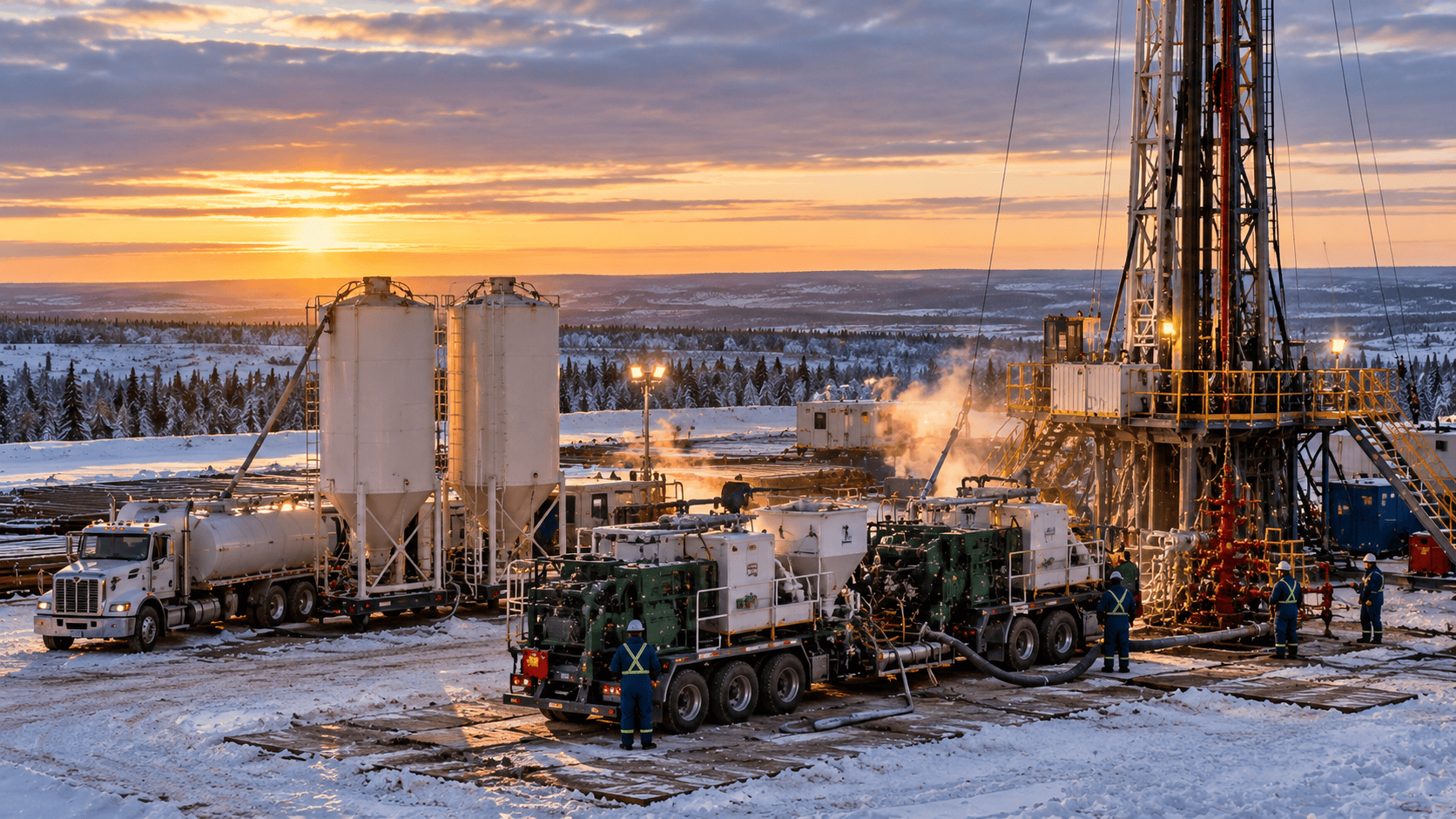
Before an oil or natural gas well can begin producing, one of the most important parts of its construction must be completed underground.
Steel casing is installed inside the wellbore, and specialized cement is pumped into the space between the casing and surrounding rock. Once properly placed and set, the cement helps support the casing and isolate underground formations.
This process is known as oilfield cementing.
Although drilling rigs and hydraulic fracturing equipment receive considerable attention, well cementing plays an equally important role in protecting groundwater, maintaining well integrity and preparing wells for production.
Cementing is also essential later in a well’s life. Existing wells may require cement repairs, while wells being permanently abandoned need suitable barriers to isolate underground formations.
These different applications have created a specialized industry across Alberta.
Calgary is an important centre for cementing engineering and corporate operations. Red Deer has numerous remedial cementing businesses, while Grande Prairie supports cementing work associated with Montney development. Other important locations include Strathmore, Nisku, Lloydminster, Bonnyville, Drayton Valley and Peace River.
This guide covers 16 companies involved in Alberta’s oilfield cementing industry. It includes contractors providing primary and remedial cementing, international cementing technology companies and specialized businesses supplying equipment, materials and well evaluation services.
The providers are organized by their actual services rather than ranked by size.
An important distinction is that some companies operate complete cement pumping units, while others manufacture downhole equipment or supply materials used by cementing contractors. These businesses are connected to the same industry but do not necessarily provide interchangeable services.
What Is Oilfield Cementing?
Oilfield cementing involves placing a carefully designed cement slurry inside a well to achieve specific mechanical and isolation objectives.
The most common application occurs during well construction.
After a section of the well has been drilled, the operator runs steel casing into the hole.
Cement is then pumped down the casing and displaced into the annular space between the casing and the surrounding formation.
When the cement sets, it forms a hardened sheath around the casing.
A properly designed and executed cement job helps support the casing, isolate formations containing different fluids and reduce the risk of unwanted fluid movement.
Cementing is not simply a matter of pumping ordinary construction cement into a hole.
The slurry must be appropriate for the well’s temperature, pressure, depth, formation characteristics and anticipated operating conditions.
For example, cement used in a shallow conventional well may have very different requirements from cement used in a deep Duvernay well or a thermal oil sands operation.
The cementing contractor must consider how the slurry will behave while being mixed, pumped and displaced.
It must remain pumpable long enough to reach its intended location.
Once placed, it must develop appropriate strength and maintain suitable sealing properties.
Cementing engineering, laboratory testing and field execution are therefore closely connected.
Primary Cementing Companies in Alberta
Primary cementing is performed during the construction of a well, usually after casing has been installed.
The work requires specialized cement blending equipment, pumping units, bulk storage, engineering and trained crews.
Several companies operating in Alberta provide these services.
1. Sanjel Energy Services
Sanjel Energy Services is one of Canada’s established oilfield cementing businesses.
The company has a long history in Western Canada’s petroleum industry and specializes in well construction, remedial cementing and abandonment services.
Sanjel provides cementing solutions for conventional oil and natural gas wells, deep horizontal wells, thermal operations and other specialized applications.
Primary cementing is a major part of its business.
The company’s services include cementing surface casing, intermediate casing, production casing and liners.
Sanjel also develops specialized cement blends for difficult well conditions.
These can include high temperatures, high pressures, gas migration risks and formations where conventional cementing methods may not be appropriate.
The company operates cement testing laboratories to help determine how cement formulations will perform under anticipated downhole conditions.
Its technical teams evaluate slurry properties such as thickening time, density and compressive strength.
Sanjel also provides remedial cementing and well abandonment services.
These operations can involve squeeze cementing, plug placement and repairs intended to restore well integrity.
The company has experience cementing demanding wells in formations such as the Montney and Duvernay.
It also develops cementing systems for carbon storage and geothermal applications.
Sanjel and STEP Energy Services
An important ownership change occurred in March 2026.
Sanjel Energy Services and STEP Energy Services completed a transaction combining their businesses.
Sanjel now operates as a division of STEP Energy Services.
The combined organization also includes Wayfinder, which supplies proppant and related materials.
This gives the parent organization a broader range of well construction and completion services, including cementing, hydraulic fracturing, coiled tubing and pressure pumping.
Sanjel continues operating under its established cementing brand.
STEP should therefore not be counted as a separate independent cementing contractor simply because it now owns Sanjel.
For Alberta producers requiring well cementing services, Sanjel remains the relevant operating business within the combined organization.
2. Magnum Cementing Services
Magnum Cementing Services is a Western Canadian oilfield service company with its corporate headquarters in Strathmore, Alberta.
The company was established in 2008 and has developed a significant cementing business across Western Canada.
Magnum provides primary cementing, remedial cementing and abandonment services.
Its Alberta locations include Strathmore, Red Deer, Grande Prairie, Lloydminster and Peace River.
These regional operations allow the company to serve different petroleum producing areas.
Magnum provides cementing services for new wells, including casing and liner cementing.
It also operates equipment used to repair existing wells and place cement barriers during abandonment programs.
The company has developed specialized products and processes for downhole isolation.
These are intended to address problems involving unwanted fluid communication between formations or damage to existing well barriers.
Magnum also provides infrastructure and fluid services through other parts of its business.
Its operations include equipment and technical capabilities associated with ground improvement and industrial projects.
For oilfield customers, however, primary and remedial cementing remain important services.
The company’s multiple Alberta locations are particularly useful because cementing operations require reliable access to bulk materials, specialized pumping units and trained crews.
A cementing job must be coordinated with the drilling rig or service rig schedule.
Having operational facilities near producing regions can help reduce mobilization requirements.
Magnum is one of the established Alberta headquartered alternatives for producers requiring cementing services across several Western Canadian fields.
3. Trican Well Service
Trican Well Service is a Calgary headquartered pressure pumping company providing hydraulic fracturing, cementing, acidizing, coiled tubing and nitrogen services.
The company operates across Western Canada and has a substantial presence in Alberta.
Cementing is one of Trican’s established service lines.
Its cementing business includes primary cementing during well construction and remedial cementing for existing wells.
Trican provides equipment and engineering services intended to support effective cement placement and long term well integrity.
The company develops specialized cement formulations for different downhole conditions.
These include wells where temperature changes, pressure variations or geological conditions create additional demands on the cement sheath.
Trican also performs remedial squeeze cementing.
Squeeze cementing is used to place cement into selected intervals where an existing well requires repair or additional isolation.
Possible applications include certain casing leaks, unwanted water movement, surface casing vent flow and gas migration problems.
Trican’s technical services include cement slurry laboratory testing and computer modelling.
Engineers can use these tools to evaluate how a cement system is expected to behave before it is pumped.
The company has also developed solutions for lost circulation.
Lost circulation occurs when fluids enter a formation rather than remaining in the intended circulation path.
This can complicate drilling and cementing because the operator may be unable to place the required amount of cement in the intended interval.
Trican’s cementing business complements its other pressure pumping operations, although cementing and hydraulic fracturing require different equipment and procedures.
For Alberta producers, Trican offers access to cementing technology within a larger well completion service organization.
Remedial Cementing and Well Abandonment Companies in Alberta
Primary cementing is only one part of Alberta’s cementing industry.
Existing oil and natural gas wells sometimes develop problems that require additional cementing work.
These problems may involve casing leaks, damaged isolation barriers, surface casing vent flow or unwanted movement of fluids between underground formations.
Remedial cementing companies specialize in repairing these conditions.
They also perform cementing during well abandonment.
Unlike some primary cementing programs, remedial work can require precise placement of relatively small volumes of cement.
Specialized pumping equipment and careful pressure control are often necessary.
4. Stingray Well Solutions
Stingray Well Solutions is an Alberta oilfield cementing company based in Red Deer.
The company specializes in remedial cementing, well abandonment and wellbore integrity repairs.
Stingray maintains operational facilities in Red Deer and Bonnyville.
It also has a forward operating base in Grande Prairie.
This allows the company to support petroleum producing regions across Central, Northern and Eastern Alberta.
Stingray’s remedial services include squeeze cementing, abandonment plugs, casing leak repairs and treatments for surface casing vent flow and gas migration.
The company also provides cementing services for conductor casing, surface casing and other well construction applications.
One of Stingray’s important capabilities is its equipment for slow rate cement pumping.
Some remedial operations require cement to be introduced very gradually.
Pumping too quickly can create unwanted pressure conditions or cause cement to enter an unintended interval.
Specialized slow rate pumps allow operators to control the placement more precisely.
Stingray also provides laboratory testing.
Its technical capabilities include testing cement thickening time, strength development, fluid loss and other important slurry properties.
The company has developed specialized cement additives and formulations for challenging remedial applications.
Stingray’s operating locations are particularly relevant to producers performing abandonment programs in mature Alberta oil and natural gas fields.
Its business focuses on engineered cementing and well integrity work rather than large hydraulic fracturing operations.
5. Performance Energy Services
Performance Energy Services is a Calgary headquartered oilfield service company specializing in remedial cementing and well abandonment.
The company began operating in 2012.
Its main operational base is in Red Deer, where much of its cementing equipment and field personnel are located.
Performance also maintains satellite operations serving Whitecourt, Drayton Valley and Grande Prairie.
Its services extend across Alberta, British Columbia and Saskatchewan.
Remedial cementing is the company’s principal specialty.
Performance performs cement squeezes, casing repairs, zonal abandonment and other well integrity operations.
The company also provides equipment for well abandonment and selected intervention work.
Its pumping units are designed for remedial applications rather than only large primary casing cement jobs.
The equipment includes specialized mixing systems and low rate pumping capability.
This is particularly important when repairing a casing leak or placing cement into a restricted interval.
Performance also provides pressure recording equipment to monitor cement pumping operations.
Beyond cementing, the company offers certain fluid pumping, acidizing and abrasive jet perforating services.
These can be used alongside remedial operations where additional access or treatment is needed before the cement can be placed.
The company’s concentration on abandonment and repairs makes it particularly relevant to Alberta’s mature producing fields.
As existing wells age, operators may need to restore isolation barriers or permanently close wells that are no longer productive.
Performance operates in this part of the market rather than focusing mainly on cementing newly drilled wells.
6. Charger Pumping Solutions
Charger Pumping Solutions is an Alberta cementing company based in Sylvan Lake.
The company specializes in remedial cementing, well abandonment and other pumping services.
Charger operates cementing equipment designed for well integrity repairs and challenging downhole conditions.
Its services include surface casing vent flow remediation, gas migration repairs, cement squeezes and abandonment cementing.
The company also performs water shutoff treatments and selected pressure pumping operations.
One of Charger’s specialties is slow rate squeeze cementing.
During these jobs, cement is pumped at carefully controlled rates into a selected part of the well.
The objective may be to repair a leak, isolate a formation or improve an existing barrier.
Charger uses equipment that allows operators to monitor and control cement density during pumping.
Maintaining the intended density is important because the cement slurry must be appropriate for the pressure and temperature conditions inside the well.
The company also operates a laboratory used for cement testing and formulation development.
Its capabilities include evaluating cement thickening time, compressive strength, rheology and other slurry properties.
Charger provides additional services such as abrasive jet cutting and pressure testing.
These can be useful when a well requires mechanical preparation before cement placement.
The company’s Sylvan Lake location provides access to Central Alberta’s extensive inventory of producing and inactive wells.
Charger is particularly focused on remedial and abandonment cementing rather than operating a large conventional drilling or fracturing fleet.
7. Challenger Technical Services
Challenger Technical Services is an Alberta oilfield company associated with the Elk Point region.
The business provides remedial cementing, abandonment cementing, stimulation and chemical pumping services.
Challenger specializes in applications where operators need to address wellbore integrity problems.
These can include surface casing vent flow and gas migration.
The company also performs cementing operations associated with well abandonment.
Challenger combines its pumping equipment with technical services intended to help determine the appropriate treatment.
For example, repairing gas migration may require understanding how gas is moving through or around the existing well barriers.
Simply pumping cement without understanding the problem may not achieve the intended result.
Challenger also provides laboratory services and chemical supply.
Its pumping operations extend into acidizing and well stimulation.
Acidizing involves introducing specially selected chemicals to remove certain deposits or treat suitable formations.
This differs from cementing, where the objective is usually to establish or restore isolation.
Challenger’s combination of cementing and stimulation services allows it to participate in different types of intervention work.
The company’s location in eastern Alberta gives it access to conventional petroleum fields and heavy oil producing regions where older wells require ongoing maintenance.
International Cementing Technology Companies With Alberta Connections
Alberta’s cementing industry also has connections to large international oilfield technology companies.
These businesses develop cement systems, pumping equipment and engineering software used in well construction around the world.
Their global product capabilities are well documented, but local cementing fleet availability should be confirmed directly because international companies do not necessarily offer every service in every operating district.
8. Halliburton
Halliburton has one of the longest histories in the Canadian oilfield cementing industry.
Its Canadian history began in Alberta in 1926, when the Halliburton Oil Well Cementing Company of Canada was established in Turner Valley.
That early business helped introduce specialized oil well cementing technology into Western Canada’s growing petroleum industry.
Today, Halliburton is a major international energy services company with a broad portfolio of cementing products and technologies.
Its cementing business includes primary well cementing, remedial cementing, specialized slurry systems and equipment for challenging downhole environments.
Halliburton develops cement formulations designed for different pressures, temperatures and geological conditions.
Its products also include systems intended to address gas migration and other well integrity risks.
The company provides cementing engineering software and technology used to evaluate slurry placement and well conditions.
Halliburton also develops specialized cementing equipment.
Cementing units must accurately mix, pump and monitor cement slurry while maintaining control of pressure and flow.
The company has invested in automated and digitally monitored cementing systems to support these operations.
Its Canadian history makes Halliburton an important part of Alberta’s cementing heritage.
However, customers looking to contract a cementing crew in Alberta should confirm current service availability with the appropriate Canadian operating district rather than assuming Halliburton’s complete international cementing portfolio is available locally.
9. SLB
SLB, formerly known as Schlumberger, is an international energy technology company with an extensive well cementing business.
The company’s cementing technology is used during well construction, remedial operations and other specialized applications.
SLB offers cement slurry systems designed for demanding operating conditions.
Its technology includes solutions intended for high temperature wells, gas migration control, lost circulation and difficult cement placement.
The company also develops equipment for measuring and controlling cementing operations.
Its land cementing units are designed to mix and pump cement while recording operational information.
SLB has developed cementing equipment specifically suited to challenging Canadian operating conditions, including requirements associated with seasonal road restrictions.
The company also provides specialized cement systems for carbon dioxide storage wells.
These applications can require attention to how cement behaves when exposed to carbon dioxide and other fluids over long periods.
SLB’s cementing portfolio extends into digital well construction and automated pumping technology.
Its international operations demonstrate how cementing continues to evolve from a primarily mechanical service into one involving extensive engineering, software and laboratory testing.
Alberta operators evaluating SLB cementing technology should confirm which pumping services, equipment and technical resources are currently offered in Canada.
Cementing Equipment and Oilfield Cement Suppliers in Alberta
Not every company involved in well cementing owns a fleet of cement pumpers.
Specialized manufacturers and suppliers provide the materials, mechanical equipment and downhole tools used by cementing contractors.
These companies are important because the success of a cement job depends on more than the pumping unit.
Casing position, slurry chemistry, downhole isolation tools and the quality of supporting equipment all affect the operation.
10. Di Corp
Di Corp is a Canadian industrial and oilfield products company with corporate operations in Calgary.
The company supplies a broad range of drilling, completion and cementing materials.
Its oilfield cement product offering includes cement, chemical additives and specialized blending materials.
Di Corp supplies oil well cement suitable for primary and remedial applications.
The company also provides additives used to modify cement slurry properties.
Different additives perform different functions.
Accelerators can reduce the time required for cement to develop strength.
Retarders can extend the period during which the slurry remains pumpable.
Extenders can reduce slurry density.
Dispersants help manage flow characteristics.
Other materials are used to control fluid loss, improve stability or modify the cement’s mechanical properties.
Di Corp also supplies products intended for thermal applications.
Thermal wells can expose cement to elevated temperatures that may affect conventional cement formulations.
Specialized materials are required to maintain suitable strength and sealing properties.
The company also provides custom blending and packaging capabilities.
Di Corp primarily supplies materials and technical products rather than providing a complete oilfield cement pumping crew.
Its role is supporting the cementing companies that design, mix and pump the slurry into the well.
11. Volant Products
Volant Products is an Edmonton based manufacturer specializing in equipment used during casing installation and well construction.
The company’s products include casing handling equipment, centralizers and specialized tubular accessories.
Centralizers are particularly important during primary cementing.
When casing is lowered into a well, it may rest against part of the surrounding wellbore.
This can create uneven clearance around the casing.
If cement cannot circulate properly around the casing, sections of the intended cement sheath may be poorly formed.
Centralizers help position the casing within the wellbore to improve the available flow space.
Volant manufactures HydroFORM centralizers designed for different casing sizes and well conditions.
The equipment is used in conventional and horizontal wells.
Some of its centralizers are designed to rotate with the casing.
This can be useful during casing installation where rotation helps manage friction or assists with wellbore conditioning.
Volant also provides engineering support to determine appropriate centralizer placement.
The correct number and location of centralizers depend on the well trajectory, casing design and expected mechanical conditions.
The company’s products support primary cementing, although Volant is not a conventional cement pumping contractor.
Its Edmonton manufacturing operations contribute to Alberta’s broader well construction equipment industry.
12. Pinnacle Oil Tools
Pinnacle Oil Tools is an Alberta downhole tool supplier with operations in Red Deer, Grande Prairie, Drayton Valley and Calgary.
The company sells, rents, services and installs equipment used in completions, workovers and well abandonment.
Pinnacle’s product range includes cement retainers and bridge plugs.
These tools are particularly important in remedial cementing.
A cement retainer is a specialized downhole tool used to help control cement placement into a selected part of the well.
It can be installed inside the casing and used with a compatible stinger assembly.
Cement can then be pumped into the intended interval.
Cement retainers are used in certain squeeze cementing and repair operations.
Pinnacle also supplies permanent and drillable bridge plugs.
Bridge plugs provide mechanical isolation inside the wellbore.
They may be used during repairs, testing and abandonment operations.
Different designs are available for different casing sizes, pressures and temperatures.
Pinnacle manufactures or supplies equipment designed to work in various well conditions.
Its operations complement those of remedial cementing contractors.
The cementing company supplies the pumping equipment and slurry, while a downhole tool company may provide the retainer or plug required to place the cement correctly.
13. FET Variperm
FET Variperm is a Canadian downhole equipment company operating under Forum Energy Technologies.
The business has significant manufacturing and engineering operations in Calgary.
Variperm is known for sand control equipment, completion tools and well intervention products.
Its equipment also supports cementing and well abandonment programs.
The company’s downhole tool inventory includes cement retainers, bridge plugs, packers and other isolation equipment.
These products can be installed during remedial operations or used to prepare wells for permanent abandonment.
For example, a bridge plug may establish mechanical isolation before cement is placed above it according to an approved procedure.
A cement retainer can assist with controlled squeeze cementing.
Variperm also provides fishing and workover tools used to prepare an existing well for repair or closure.
This can involve removing equipment or gaining access to an interval requiring isolation.
The company has field operations supporting producers across Western Canada, including Alberta and Saskatchewan.
Its business is focused on downhole equipment and technical support rather than conventional primary casing cement pumping.
Variperm is particularly relevant to remedial cementing projects that require specialized mechanical tools in addition to the cement itself.
14. Weatherford
Weatherford is an international oilfield technology company with products used in drilling, completions and well intervention.
Its well construction portfolio includes equipment designed to improve cement placement.
Weatherford supplies centralizers, float equipment, stage cementing tools and other casing accessories.
These products are used during primary cementing.
Float shoes and float collars are installed as part of the casing string.
They assist with the circulation and placement of cement and help control unwanted reverse flow during appropriate cementing operations.
Stage cementing tools allow cement to be placed in separate stages where the well design requires that approach.
This may be important when formations cannot safely support the pressure associated with placing the entire cement column in one operation.
Weatherford also manufactures centralizers to help maintain suitable clearance around casing.
Its engineering teams develop equipment for different well geometries and operating conditions.
The company’s cementing technology is part of a much broader oilfield services portfolio.
Weatherford should not automatically be considered equivalent to an Alberta contractor supplying a complete primary cement pumping fleet.
Its casing and cementing tools can be relevant to operators and well construction contractors selecting downhole equipment for cementing programs.
Cement Evaluation and Pumping Equipment Support Companies
After cement is placed, operators may need to evaluate the result.
Cementing equipment also requires regular inspection and maintenance because it operates under demanding mechanical and pressure conditions.
The following Alberta companies support those activities.
15. Spectrum Wireline Services
Spectrum Wireline Services is an Alberta company with operations in Calgary and Red Deer.
The company provides wireline logging, perforating, pipe recovery and specialized well evaluation services.
One of its important capabilities is cement evaluation.
Spectrum provides cement bond logging and other measurements used to assess conditions behind casing.
After a well has been cemented, an operator may need information about whether the cement appears to provide the intended isolation.
Cement bond logging uses specialized downhole measurements to evaluate aspects of the casing and cement system.
The information can help identify intervals where further investigation or remedial work may be necessary.
Spectrum also provides cement density logging and related casing evaluation services.
Another specialized product is its cement core logging tool, which the company markets for identifying cement plugs in cased wells.
This can be useful during certain abandonment verification programs.
Spectrum also provides wireline equipment used to set downhole tools and perform other well intervention tasks.
The company does not primarily operate conventional cement pumping fleets.
Its role is providing measurement and technical services that can support cementing, remedial repairs and well abandonment.
16. JC Inspections and Valve Service
JC Inspections and Valve Service is an Alberta equipment inspection company with operations in Red Deer and Clairmont near Grande Prairie.
The business specializes in inspecting and servicing oilfield pressure pumping equipment.
Its work includes equipment used in hydraulic fracturing, coiled tubing, nitrogen pumping, acidizing and cementing.
Oilfield cementing equipment operates with pressurized fluid systems.
Pumps, valves, manifolds, cement heads and pressure lines must be maintained and inspected according to the applicable requirements.
JC Inspections provides services intended to help equipment operators identify wear, damage and mechanical problems.
The company also performs pressure testing and equipment inspection.
Cementing heads and high pressure iron are among the components associated with cementing equipment.
The company’s Red Deer operation supports Central Alberta’s large oilfield service industry.
Its Clairmont location provides access to equipment used around Grande Prairie and the Montney.
JC Inspections is not a cementing contractor that pumps cement into oil and natural gas wells.
It is a supporting service provider helping contractors maintain the equipment required for those operations.
Where Are Cementing Companies Located in Alberta?
Alberta’s oilfield cementing businesses are concentrated around major drilling regions and established energy service communities.
The location of these companies matters because cementing operations require equipment, bulk materials and crews to be mobilized to the wellsite.
Cementing Companies in Grande Prairie
Grande Prairie is one of Alberta’s important markets for primary and remedial cementing.
The region supports Montney development and conventional oil and natural gas production.
Sanjel, Magnum, Trican and other established contractors serve the broader region.
Stingray has also established cementing support infrastructure in Grande Prairie.
Performance Energy maintains a regional presence.
Several downhole tool and equipment suppliers also operate nearby.
Grande Prairie is particularly important because Montney wells can be deep and mechanically demanding.
Cementing these wells requires careful consideration of well geometry, pressure, temperature and formation conditions.
Existing wells in the region can also require squeeze cementing or abandonment work.
Cementing Companies in Red Deer
Red Deer is a major centre for remedial cementing and well abandonment services.
Stingray Well Solutions and Performance Energy maintain important operations in the region.
Magnum also has a Red Deer operating station.
The nearby community of Sylvan Lake is home to Charger Pumping Solutions.
These businesses support conventional well repairs, gas migration remediation, casing repairs and abandonment projects.
Red Deer also contains downhole tool suppliers and specialized equipment inspection businesses.
Its central location allows crews to serve a large portion of Alberta.
Cementing Companies in Calgary
Calgary is a major centre for cementing engineering and corporate operations.
Sanjel, Trican and Performance Energy maintain corporate connections to the city.
Magnum also has a corporate presence in the Calgary region through Strathmore.
Di Corp supplies cementing materials and additives.
Volant, Variperm and other well construction technology businesses support the broader cementing market through engineering and manufacturing.
Calgary is especially important for planning cementing programs and developing specialized slurry formulations.
Cementing Companies in Strathmore
Strathmore is the headquarters location for Magnum Cementing Services.
The company maintains corporate, operational and laboratory facilities in the community.
Strathmore is located east of Calgary and provides access to major transportation routes.
Its position allows cementing equipment to serve Southern and Central Alberta while maintaining connections with Calgary’s energy industry.
Cementing Companies in Lloydminster and Bonnyville
Lloydminster and Bonnyville are important markets for conventional, heavy oil and thermal well operations.
Magnum maintains a Lloydminster operating station.
Stingray operates from Bonnyville.
Other cementing contractors may mobilize into the region according to customer requirements.
The area contains large inventories of producing and inactive wells.
This creates demand for both new well cementing and remedial operations.
Thermal production can also require specialized cement formulations capable of tolerating elevated temperatures.
Cementing Companies in Whitecourt and Drayton Valley
Whitecourt and Drayton Valley are important conventional oil and natural gas producing regions.
Performance Energy maintains satellite operations serving these areas.
Other cementing contractors dispatch equipment from Central Alberta and nearby service centres.
Existing wells in these regions may require casing repairs, surface casing vent flow remediation, squeeze cementing or abandonment.
Types of Oilfield Cementing Services in Alberta
The term cementing covers several different operations.
Understanding the differences helps explain why not every cementing company provides the same services.
Primary Cementing
Primary cementing is performed during well construction.
Cement is placed around casing or liners to provide mechanical support and establish the required isolation.
The program must be designed according to the well’s geometry, expected pressures, geological formations and regulatory requirements.
Sanjel, Magnum and Trican are among the established providers offering primary cementing in Alberta.
Surface Casing Cementing
Surface casing is installed in the upper section of a well.
One of its important purposes is helping protect shallow groundwater and supporting subsequent drilling operations.
The casing must be cemented according to the approved well construction requirements.
Surface casing cementing is an important operation because later repairs can be difficult and expensive.
Intermediate Casing Cementing
Intermediate casing is installed where the well design requires additional isolation or mechanical support before deeper drilling continues.
Cement is placed around the casing according to the well program.
The operation may be complicated by pressure differences or formations that are sensitive to fluid losses.
Production Casing Cementing
Production casing is installed through the interval that will ultimately be completed for oil or natural gas production.
The cementing program must account for the intended completion method.
In horizontal wells, cement placement can be particularly challenging because the casing extends through a long deviated or horizontal section.
Proper casing centralization and mud removal are important considerations.
Liner Cementing
A liner is a casing string that does not necessarily extend all the way to the surface.
It is suspended inside a previous casing string.
Liner cementing involves placing cement around the liner according to the well construction plan.
Specialized liner hangers and cementing equipment may be required.
Remedial Cementing
Remedial cementing involves placing additional cement in an existing well to address a specific problem.
The objective may be to restore zonal isolation, repair a leak or establish a required barrier.
Remedial work can involve a variety of specialized techniques.
The correct method depends on the condition of the well.
Squeeze Cementing
Squeeze cementing is a remedial operation in which cement is placed into a selected interval under controlled pumping conditions.
The cement may be used to repair certain leaks or improve isolation.
Specialized low rate pumping equipment can be important when treating small openings or restricted intervals.
Stingray, Performance Energy, Charger, Challenger, Magnum, Sanjel and Trican provide services relevant to this type of work.
Surface Casing Vent Flow Remediation
Surface casing vent flow occurs when gas or fluid moves through the surface casing vent system.
Some vent flows require investigation and corrective action.
The appropriate response depends on the flow characteristics and applicable regulatory requirements.
Remedial cementing may be one method used to address the problem.
The operator must understand the source and pathway of the flow before selecting a treatment.
Gas Migration Remediation
Gas migration can occur when gas moves through unintended pathways outside the well.
This may involve problems with the cement sheath or other well integrity conditions.
Remedial cementing can be used in suitable cases to restore isolation.
However, not every gas migration problem can be solved through the same cement treatment.
Well evaluation and technical planning are important.
Abandonment Cementing
When a well is permanently abandoned, suitable barriers must be established to isolate underground formations.
Cement plugs are commonly used during these operations.
Depending on the well, other mechanical barriers and remedial work may also be required.
Alberta’s abandonment requirements are established by the Alberta Energy Regulator.
The exact procedures depend on the well’s condition, completion design and regulatory requirements.
Thermal Well Cementing
Thermal wells can experience high temperatures and repeated changes in temperature and pressure.
This is particularly relevant to steam assisted gravity drainage and other thermal heavy oil operations.
The cement system must be designed to tolerate the anticipated environment.
Specialized cement additives and formulations may be required.
Carbon Storage Well Cementing
Carbon storage wells are designed to inject carbon dioxide into suitable underground formations.
These wells require appropriate isolation and long term well integrity.
Cement selection must consider the anticipated fluids and operating conditions.
Some conventional cement systems may require modification for particular carbon dioxide environments.
Sanjel, SLB and other cementing technology companies have developed products associated with carbon storage applications.
Why Cementing Is Especially Important in Horizontal Wells
Modern Alberta wells can extend considerable distances underground.
A horizontal well may initially be drilled vertically before turning into the target geological formation.
The casing must follow that well trajectory.
This creates challenges during cementing.
In a vertical well, gravity helps influence how fluids move around the casing.
In a horizontal section, the distribution of fluids can be more complicated.
The casing may also rest closer to the lower side of the wellbore.
This can reduce the space available for cement flow.
Centralizers are used to help manage casing position.
The cementing program must also consider fluid displacement, pumping rates and the properties of the drilling fluid already in the well.
Poor displacement can leave unwanted material in the annulus.
That can affect cement bonding and the intended isolation.
These challenges make cementing engineering and casing equipment particularly important in the Montney and Duvernay.
How Cementing Companies Support Alberta Well Abandonments
Well abandonment is becoming an increasingly important source of work for Alberta’s cementing industry.
The province has a substantial inventory of inactive oil and natural gas wells.
When these wells reach the end of their productive lives, they must be properly abandoned.
Abandonment work can include removing completion equipment, evaluating well integrity and installing barriers.
Cementing companies may be responsible for preparing, mixing and placing the cement used to isolate underground formations.
Some projects are relatively straightforward.
Others involve damaged casing, gas migration, restricted well access or complicated historical completion designs.
These situations may require remedial cementing before the final abandonment barriers can be established.
Specialized companies such as Stingray, Performance Energy, Charger and Challenger focus heavily on this market.
Larger providers such as Sanjel, Magnum and Trican also offer remedial and abandonment services.
The work often requires coordination with service rig companies, wireline contractors, downhole tool suppliers and abandonment consultants.
As Alberta continues addressing inactive well liabilities, cementing remains an essential part of the physical work required to close wells properly.
What Equipment Is Used During Oilfield Cementing?
A cementing operation involves several different types of equipment.
The exact configuration depends on the size and complexity of the job.
Cement Pumping Units
Cement pumping units mix and pump cement slurry into the well.
They must control pumping rate and pressure according to the cementing program.
Some units are designed for high volume primary cementing.
Others specialize in smaller remedial treatments.
Bulk Cement Storage
Dry cement is commonly stored in bulk tanks or silos.
The equipment must keep the material dry and allow it to be delivered to the mixing system.
Bulk storage is important when a job requires a substantial cement volume.
Cement Blenders
Cement blending equipment combines dry cement, water and selected additives to create the intended slurry.
Maintaining the correct proportions is essential.
The slurry must have the required properties for placement and setting.
Batch Mixers
Some cementing operations use batch mixing equipment.
The slurry is mixed and prepared before being pumped into the well.
This can be useful where particular treatment volumes or mixing requirements make batch preparation appropriate.
Cementing Heads
A cementing head is installed at the surface as part of the cementing system.
It can be used to launch cementing plugs and control aspects of the cementing operation.
The equipment must be appropriate for the casing and pressure requirements.
Cementing Plugs
Cementing plugs help separate fluids during certain casing cementing operations.
They can reduce contamination between the cement slurry and other fluids.
Different plug arrangements are used according to the cementing procedure.
Centralizers
Centralizers help maintain the desired position of casing inside the wellbore.
They can improve the space available for cement circulation.
Different designs are used for vertical, deviated and horizontal wells.
Float Equipment
Float collars and float shoes are installed in the casing string.
They assist with cement circulation and can help prevent unwanted reverse flow after pumping.
Cement Retainers
Cement retainers are specialized downhole tools used during certain remedial cementing operations.
They help control cement placement into selected intervals.
Bridge Plugs
Bridge plugs create mechanical barriers inside wells.
They can be used during repairs, testing and abandonment programs.
Some designs are intended to remain in place, while others can be drilled or milled out.
How to Choose a Cementing Company in Alberta
Choosing an oilfield cementing contractor requires careful consideration of the well and the intended operation.
The correct supplier depends on more than the price of pumping equipment.
Determine Whether the Job Is Primary or Remedial
A new well requiring production casing cementing may need a high volume primary cementing unit.
A casing leak repair may require specialized slow rate equipment.
The contractor should have suitable equipment and experience for the specific operation.
Consider Well Depth and Temperature
Deep wells can experience high pressures and temperatures.
Thermal wells can create additional temperature challenges.
The cement formulation and pumping program must account for these conditions.
A contractor should be able to explain how the proposed slurry has been evaluated.
Review Laboratory Testing
Cement slurry properties are important to the success of the operation.
Laboratory testing can help predict thickening time, strength development, fluid loss and other characteristics.
For difficult wells, a company with suitable laboratory and engineering support may provide important advantages.
Consider Cement Placement Engineering
The cementing program should account for the casing design, well trajectory, drilling fluid properties and anticipated displacement conditions.
Proper planning is especially important in long horizontal wells.
The operator should understand how the contractor intends to place cement in the required interval.
Confirm Equipment Availability
Cementing operations are closely connected to drilling and servicing schedules.
A delayed cement job can affect the entire project.
The contractor should confirm that the necessary pumping equipment, bulk materials and personnel will be available when needed.
Review Experience With Similar Wells
A contractor experienced in shallow conventional cementing may not have the same equipment or technical background as one specializing in deep horizontal wells.
Similarly, remedial cementing requires different skills from routine primary cementing.
Experience with comparable operations should be considered.
Evaluate Inspection and Maintenance
Cementing units operate with pressurized fluids and mechanical pumping systems.
Equipment inspection and maintenance are essential.
The contractor should maintain appropriate records for pumps, pressure lines and other critical components.
Confirm Supporting Equipment
Some cementing operations require additional downhole tools or evaluation services.
These may include cement retainers, bridge plugs, wireline logging or specialized casing equipment.
The operator should confirm which services are provided directly and which require separate contractors.
Frequently Asked Questions About Cementing Companies in Alberta
What Are the Major Oilfield Cementing Companies in Alberta?
Sanjel Energy Services, Magnum Cementing Services and Trican Well Service are established providers of primary and remedial cementing.
Stingray Well Solutions, Performance Energy Services, Charger Pumping Solutions and Challenger Technical Services specialize in remedial, abandonment or other targeted cementing applications.
Halliburton and SLB also have extensive international cementing technology businesses, although specific Alberta service availability should be confirmed directly.
Which Companies Provide Primary Cementing in Alberta?
Sanjel, Magnum and Trican provide primary casing cementing.
Stingray and Charger also advertise primary cementing capabilities alongside their remedial services.
The appropriate contractor depends on the casing design, well conditions and job requirements.
Which Companies Provide Remedial Cementing in Alberta?
Remedial cementing providers include Stingray Well Solutions, Performance Energy Services, Charger Pumping Solutions, Challenger Technical Services, Magnum, Sanjel and Trican.
The services available differ between contractors.
Some specialize in slow rate squeeze cementing, while others operate a broader selection of pumping equipment.
Which Cementing Companies Operate in Grande Prairie?
Sanjel, Magnum and other large cementing providers serve the Grande Prairie region.
Stingray and Performance Energy also maintain regional support arrangements.
Grande Prairie is important because of Montney development and the large number of existing oil and natural gas wells throughout northwestern Alberta.
Which Cementing Companies Are Based in Red Deer?
Stingray Well Solutions and Performance Energy Services have important Red Deer operations.
Magnum also maintains a Red Deer operating station.
Charger Pumping Solutions operates from nearby Sylvan Lake.
Are There Cementing Companies in Lloydminster?
Magnum maintains an operating station in Lloydminster.
Other cementing contractors serve the region from nearby Alberta operating bases.
The Lloydminster area requires cementing for conventional wells, heavy oil production, thermal operations and well abandonments.
Which Companies Provide Cementing for Well Abandonments?
Sanjel, Magnum, Trican, Stingray, Performance Energy, Charger and Challenger provide services associated with remedial cementing or well abandonment.
Downhole tool suppliers such as Pinnacle Oil Tools and FET Variperm can provide mechanical equipment used during selected abandonment operations.
Which Companies Supply Oilfield Cement and Additives?
Di Corp supplies oil well cement and a broad range of additives used in cementing operations.
Larger cementing contractors also maintain their own material sourcing, blending and laboratory capabilities.
Which Alberta Companies Supply Cementing Tools?
Volant Products manufactures casing centralizers and related well construction equipment.
Pinnacle Oil Tools and FET Variperm supply cement retainers, bridge plugs and other downhole isolation products.
Weatherford also provides equipment used during casing cementing, including float equipment and stage cementing tools.
What Is the Difference Between Primary Cementing and Squeeze Cementing?
Primary cementing is generally performed during construction of a well to place cement around casing or liners.
Squeeze cementing is a remedial operation used to place cement into a selected interval.
Squeeze cementing may be performed to repair certain leaks or establish additional isolation.
Is Cementing the Same as Hydraulic Fracturing?
No.
Cementing is generally used to support casing and establish or restore isolation barriers.
Hydraulic fracturing uses fluid pressure to create fractures in a reservoir and improve the movement of oil or natural gas.
Both operations involve pressure pumping equipment, but they have different purposes.
Some companies, including Trican, operate in both markets.
Does STEP Energy Services Provide Cementing?
STEP Energy Services became the parent organization of Sanjel Energy Services following their March 2026 combination.
Sanjel remains the cementing operating division.
STEP’s other services include hydraulic fracturing, coiled tubing, fluid pumping and nitrogen pumping.
Does Calfrac Provide Cementing in Alberta?
Calfrac is headquartered in Calgary and provides hydraulic fracturing and coiled tubing services in North America.
Although Calfrac advertises cementing services internationally, its current company information identifies cementing as part of its Argentina operations.
It should therefore not automatically be listed as a current Alberta cementing contractor based solely on the company’s international cementing portfolio.
How Is a Cement Job Evaluated?
Cementing contractors monitor important information during pumping, including slurry density, pressure, rate and volume.
After the operation, additional evaluation may be performed where required.
Cement bond logging and related measurements can help assess aspects of the cement and casing system.
However, no single measurement necessarily provides a complete picture of every possible cementing problem.
The evaluation method depends on the well and the intended isolation requirements.
What Jobs Are Available With Alberta Cementing Companies?
Cementing companies employ equipment operators, cementing supervisors, engineers, laboratory technologists, mechanics, drivers and other field personnel.
Some positions involve operating specialized pumping units.
Others focus on equipment maintenance, cement formulation or technical planning.
Commercial driving qualifications can be important because much of the equipment is transported between wellsites.
Employment opportunities depend on current drilling activity, workover programs and abandonment spending.
Cementing Will Remain Essential Throughout the Life of Alberta’s Wells
Every producing oil or natural gas well depends on maintaining suitable barriers between underground formations.
Cementing is one of the most important methods used to establish those barriers.
New wells require cement during construction.
Existing wells may require remedial cementing when problems develop.
Older wells eventually require abandonment work that can include permanent cement barriers.
These different stages create demand for several types of cementing businesses.
Sanjel, Magnum and Trican provide broad cementing services associated with well construction and existing wells.
Stingray, Performance Energy, Charger and Challenger focus strongly on remedial cementing and well abandonment.
International technology companies develop specialized cement systems and equipment.
Alberta manufacturers and suppliers provide the chemicals, centralizers, retainers, bridge plugs and other tools used during cementing operations.
Evaluation and inspection companies support the process by providing downhole measurements and equipment testing.
The importance of cementing is also changing as Alberta’s wells become more technically demanding.
The Montney and Duvernay require careful engineering for deep and long horizontal wells.
Thermal oil sands operations need cement systems capable of handling elevated temperatures.
Mature conventional producing fields create demand for remedial cementing and abandonment.
Carbon storage and other emerging subsurface projects introduce additional requirements for long term well integrity.
For producers selecting a cementing contractor, the main considerations remain the type of work, technical experience, suitable equipment, slurry design and the ability to execute the program safely.
No single cementing method is appropriate for every well.
That is why Alberta’s combination of major cementing companies, independent remedial specialists and specialized equipment suppliers remains important.
From Strathmore and Calgary to Red Deer, Grande Prairie, Lloydminster and Bonnyville, these businesses support the construction, maintenance and eventual closure of Alberta’s oil and natural gas wells.
Much of the work happens underground and is never visible once the well begins producing.
But the quality of that work can influence the integrity of the well throughout its operating life and long after production has ended.