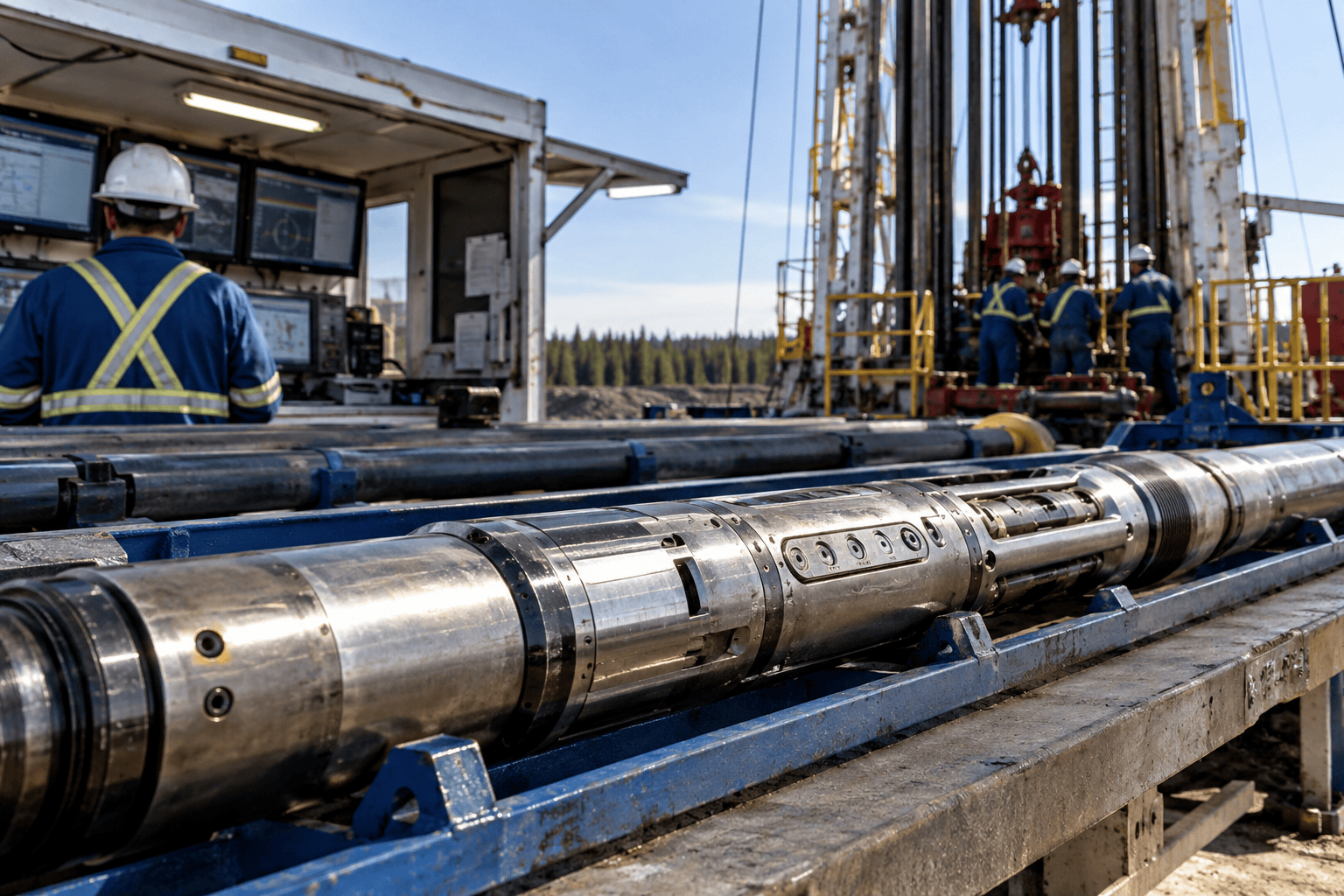
Thousands of metres below an Alberta drilling rig, specialized electronic instruments are helping directional drillers determine exactly where the drill bit is heading.
These instruments measure the direction and inclination of the wellbore, collect information about drilling conditions and transmit selected measurements to the surface while drilling continues.
The technology is known as Measurement While Drilling, or MWD.
Without reliable downhole measurements, constructing modern horizontal oil and natural gas wells would be considerably more difficult.
A well targeting the Montney near Grande Prairie may need to remain within a particular geological interval over a long horizontal distance. A Duvernay well near Fox Creek may require precise directional control while navigating a deep and technically demanding reservoir.
Thermal oil sands operations present different challenges. Steam injection and production wells must be positioned according to carefully designed well plans, sometimes requiring specialized ranging and surveying technology to determine their relative positions.
Alberta has developed a substantial industry supplying the equipment and expertise needed for these operations.
Companies such as Phoenix Technology Services, Altitude Energy Partners, Pacesetter Directional Drilling and Mostar Directional Technologies provide directional drilling and MWD services.
Other Alberta businesses specialize in electronic measurement systems, mud pulse telemetry, electromagnetic communications, downhole sensors and equipment manufacturing.
International companies such as Halliburton, Baker Hughes, SLB and Weatherford also provide advanced drilling measurement technologies.
This guide examines 19 companies involved in Measurement While Drilling services and equipment relevant to Alberta’s oil and natural gas industry.
It includes directional drilling contractors that provide MWD personnel and field equipment, specialized measurement service providers, and technology manufacturers supplying the tools used by drilling crews.
The companies are organized by their principal services rather than ranked by size.
An important distinction is that not every MWD technology manufacturer provides a complete directional drilling crew. Some companies supply instruments, software or replacement components to the contractors performing the actual wellsite operations.
What Is Measurement While Drilling?
Measurement While Drilling is the process of collecting information about a wellbore using instruments installed in the drilling assembly.
The instruments are normally positioned near the lower end of the drill string, above the drill bit.
As drilling progresses, sensors collect information about the orientation and conditions of the well.
Common measurements include inclination, azimuth, toolface orientation, temperature and, where appropriate sensors are installed, drilling dynamics and pressure.
Inclination describes the angle of the wellbore relative to vertical.
Azimuth describes its direction relative to north.
Toolface orientation helps directional drillers understand the direction a steering assembly is pointed.
Together, these measurements allow the drilling team to determine where the well is travelling and whether adjustments are necessary.
The information is transmitted from underground to the surface using specialized telemetry equipment.
The two common methods are mud pulse telemetry and electromagnetic telemetry.
Some advanced tools support both methods.
At the surface, the signals are decoded and displayed through computer systems.
Directional drillers and MWD personnel use the information to monitor the well trajectory.
The objective is to drill the planned well accurately while managing technical risks and avoiding unnecessary drilling time.
Directional Drilling Companies Providing MWD Services in Alberta
The following companies provide MWD technology as part of directional drilling or dedicated downhole measurement services.
Their equipment and field capabilities differ, so the appropriate provider depends on the well design and technical requirements.
1. Phoenix Technology Services
Phoenix Technology Services is a Calgary headquartered directional drilling company operating under PHX Energy Services Corporation.
The company was established in 1995 and has developed an extensive business providing directional drilling and downhole measurement technology.
Phoenix operates in Canada, the United States and international markets.
Its services include directional drilling, MWD, drilling motor rentals, gyro surveying, survey management and drilling optimization.
Phoenix MWD Technology
Phoenix develops and uses proprietary measurement systems.
Its P360 system uses positive mud pulse telemetry.
The equipment transmits downhole information by creating controlled pressure changes in the drilling fluid.
These changes are detected at the surface and converted into measurements.
The P360 system can transmit directional and gamma ray data, depending on its configuration.
Phoenix also developed the E360 electromagnetic MWD system.
This equipment communicates using electrical signals transmitted through the surrounding geological formations rather than depending on mud pressure pulses.
Electromagnetic telemetry can be useful in selected drilling conditions where conventional mud pulse systems present difficulties.
The suitability of either method depends on depth, formation conductivity, drilling fluid and other conditions.
Directional Drilling and Well Planning
Phoenix combines MWD equipment with directional drilling personnel and engineering.
Its services include well trajectory planning, collision avoidance analysis and survey management.
The company also supplies performance drilling motors and rotary steerable technology.
These products perform different functions but work together during directional drilling.
MWD equipment measures the well’s orientation.
The steering assembly is used to change or maintain the drilling direction.
Phoenix maintains a substantial Calgary operations and technical facility.
The company is particularly relevant to producers drilling horizontal oil and natural gas wells in Alberta’s major unconventional formations.
2. Altitude Energy Partners
Altitude Energy Partners is a directional drilling and MWD service business operating in Canada under ACT Energy Technologies.
The parent company is headquartered in Calgary.
Altitude provides directional drilling, Measurement While Drilling, rotary steerable systems, drilling motors and remote operations support.
Formerly Cathedral Energy Services
An important ownership and naming change occurred in July 2024.
Cathedral Energy Services changed its corporate name to ACT Energy Technologies.
At the same time, the company’s Canadian directional drilling operations were rebranded as Altitude Energy Partners.
ACT remains the corporate parent, while Altitude is the directional drilling operating brand.
This means Cathedral Energy Services and Altitude Energy Partners should not be listed as separate independent Canadian MWD contractors.
The business also includes technology and equipment operations associated with the former Cathedral organization.
MWD and Remote Drilling Operations
Altitude provides directional measurement equipment and personnel for drilling programs.
Its services include downhole surveying, steering support and the collection of drilling measurements.
The company also provides remote directional drilling and MWD operations.
Remote operations allow certain monitoring and technical tasks to be performed from a support centre rather than requiring every specialist to remain physically at the rig.
However, the amount of work that can be performed remotely depends on the equipment, communications and operating arrangement.
Altitude also provides drilling motors and rotary steerable systems.
Its business is relevant to horizontal drilling programs in Alberta and other North American producing regions.
Precision and Ensign Ownership History
Two historical transactions are important when researching the current Canadian market.
Cathedral acquired Precision Drilling’s Canadian directional drilling business in 2021.
It also acquired Ensign’s Canadian directional drilling business in 2022.
Those acquired businesses became part of Cathedral’s expanding directional drilling operations, which subsequently adopted the Altitude name.
Older listings showing Precision Directional Services or Ensign Directional as separate Canadian MWD contractors may therefore describe former operating arrangements rather than current independent service providers.
3. Pacesetter Directional Drilling
Pacesetter Directional Drilling is a Calgary based company specializing in directional drilling and downhole measurement technology.
The company was established in 2005.
Pacesetter provides MWD, drilling motors, rotary steerable systems and well planning services.
It develops some of its own MWD technology and maintains technical facilities in Calgary.
XPACE Electromagnetic MWD
One of Pacesetter’s principal technologies is the XPACE electromagnetic MWD system.
The equipment transmits directional and other downhole measurements using electromagnetic communication.
Depending on the tool configuration, the system can provide inclination, azimuth, gamma ray, pressure and drilling dynamics information.
Pacesetter’s technology also allows downhole measurements to be monitored while drilling.
This can be useful when a producer needs detailed information to maintain the well trajectory.
Redline Mud Pulse Technology
Pacesetter also provides Redline mud pulse MWD systems.
Mud pulse technology is commonly used where the drilling fluid circulation system provides a suitable communication path.
Pacesetter’s equipment portfolio allows different telemetry methods to be selected according to the well.
Rotary Steerable Systems
Pacesetter provides rotary steerable technology in addition to conventional directional drilling motors.
Its equipment has been used in Alberta formations such as the Montney, Duvernay, Cardium, Wilrich and Fahler.
The company has published Canadian drilling examples involving the combination of MWD equipment and rotary steerable assemblies.
Pacesetter is particularly relevant to producers seeking one contractor for directional drilling equipment, measurement technology and well planning.
4. Mostar Directional Technologies
Mostar Directional Technologies is a Calgary headquartered directional drilling company established in 2005.
The company provides directional drilling services, MWD equipment, drilling motors, well planning and technical support.
Mostar also has its own engineering and manufacturing capabilities.
Dual Telemetry MWD
Mostar has developed technology combining electromagnetic and mud pulse measurement systems.
The purpose is to provide more flexibility when downhole conditions affect one communication method.
For example, electromagnetic telemetry can become less reliable in certain geological formations.
Mud pulse communication has different limitations involving drilling fluid and operating conditions.
A system with access to both technologies can provide alternatives when the drilling environment changes.
Mostar’s expertise includes the integration of telemetry equipment with directional drilling motors.
Equipment Manufacturing and Repair
Mostar designs, manufactures and services its own drilling motors.
It also provides machining, engineering and equipment inspection.
This is an important distinction from companies that primarily rent tools manufactured by outside suppliers.
Having manufacturing and service capabilities allows Mostar to maintain and modify equipment for selected drilling requirements.
The company also develops software used to interpret and display downhole information.
Mostar serves Canadian and United States drilling markets, with its Canadian operations based in Calgary.
5. Clear Directional Drilling Solutions
Clear Directional Drilling Solutions is an Alberta company providing directional drilling, MWD and well planning services.
Its corporate office is in Calgary, with an operating location in Stony Plain.
Clear provides drilling services for horizontal and directional wells.
The company also supplies downhole tools and technical support.
Measurement While Drilling
Clear’s services include MWD equipment used for directional surveying and well placement.
The company offers equipment incorporating inclination measurements and gamma ray logging.
Near bit and at bit measurement technologies are among its advertised capabilities.
These tools can provide information closer to the drill bit than a conventional sensor positioned farther up the drilling assembly.
That can be useful when a well must remain within a narrow geological target.
Well Planning and Collision Avoidance
Clear also provides well trajectory planning.
Its engineering services include collision avoidance analysis, torque and drag calculations and wellbore design.
Collision avoidance is particularly important when multiple wells are drilled from the same surface pad.
A producer must understand the planned positions of existing and proposed wellbores.
Clear also supplies drilling motors and MWD equipment rentals.
This allows its services to support different drilling programs depending on the equipment required.
6. New Discovery Directional Drilling
New Discovery Directional Drilling is an Alberta company headquartered in Calgary.
The business was established in 2009.
It provides directional drilling, MWD, drilling motors and well planning.
New Discovery maintains an MWD facility in Airdrie and a drilling motor facility in Leduc.
These locations are particularly useful for supporting Western Canadian field operations.
Electromagnetic MWD
New Discovery operates electromagnetic measurement systems designed for horizontal drilling.
The company uses electric dipole telemetry technology to transmit directional data through geological formations.
Its equipment includes gamma ray logging capabilities.
Gamma ray measurements are important because they help identify changes in formation characteristics as drilling progresses.
The company also offers near bit measurement technology.
Positive Mud Pulse Systems
For wells where electromagnetic telemetry may be unsuitable, New Discovery also provides positive mud pulse equipment.
This creates an alternative method for transmitting directional measurements.
The company can select an appropriate system based on the anticipated well conditions.
Drilling Motors and Engineering
New Discovery maintains its own drilling motor equipment.
It also provides engineering support for well trajectory design, collision avoidance, hydraulics and drilling performance.
The company’s Airdrie MWD facility supports equipment maintenance and preparation before tools are sent to the field.
New Discovery is particularly relevant to producers looking for a regional Alberta directional drilling contractor with dedicated measurement and motor facilities.
7. OptiMax Drilling Solutions
OptiMax Drilling Solutions is a Calgary based directional drilling company established in 2008.
The company specializes in MWD, directional drilling, drilling motors and drilling optimization.
OptiMax combines field equipment with software designed to evaluate drilling performance.
Electromagnetic and Mud Pulse MWD
OptiMax provides electromagnetic MWD technology under its E2MAX product line.
This equipment transmits measurements using electromagnetic signals.
It can be used in suitable operations involving conventional drilling fluids or compressible drilling fluids.
OptiMax also offers P2MAX positive mud pulse MWD.
This technology transmits measurements through pressure pulses in the drilling fluid.
The company provides additional measurement options, including gamma ray sensors and near bit inclination equipment.
Drilling Optimization
OptiMax also operates its DEEPVIEW drilling optimization system.
This technology processes drilling information to help identify conditions that may affect drilling performance.
Examples include vibration, inefficient drilling parameters and other downhole problems.
The objective is to provide information that helps the drilling team make informed adjustments.
OptiMax also supplies drilling motors and well planning services.
The company is particularly relevant to producers seeking MWD equipment alongside drilling performance analysis.
8. KAMBI Enterprises
KAMBI Enterprises is a Calgary based company specializing in wellbore navigation and logging technology.
The company was established in 1999.
Its business includes MWD and LWD services, equipment rentals, sales, maintenance and technical support.
KAMBI provides measurement technology used during directional drilling.
MWD Equipment Rentals
KAMBI supplies MWD equipment through rental, leasing and sales arrangements.
This differs from a contractor that only offers equipment as part of a complete directional drilling service package.
A drilling service company may need measurement tools without purchasing an entire new equipment fleet.
KAMBI can provide systems for those requirements.
Electromagnetic and Mud Pulse Systems
KAMBI’s equipment includes electromagnetic MWD and positive mud pulse technology.
The company also supplies logging while drilling equipment.
Its services include assembly, inspection, equipment repair and technical support.
Equipment Maintenance
MWD instruments operate inside the drilling assembly under high vibration and mechanical loads.
Electronics, batteries, sensors and other components require careful inspection.
KAMBI provides maintenance and repair services for its equipment.
The company also supports custom measurement tool development.
KAMBI represents the part of Alberta’s MWD industry that combines technology services with equipment supply and maintenance.
9. Fasdrill
Fasdrill is a directional drilling and measurement technology company with a Canadian office in Calgary.
The company began operating in 2008.
Its business includes MWD systems, logging while drilling equipment, drilling motors and field services.
Fasdrill also supplies equipment internationally.
Positive Pulse and Electromagnetic MWD
Fasdrill offers positive pulse MWD systems used for directional surveying.
It also supplies electromagnetic measurement technology.
Both options are available through equipment sales and rental arrangements.
The company advertises systems that can be configured for different drilling conditions.
Multiple Telemetry Options
Fasdrill also offers equipment with multiple telemetry capabilities.
These systems provide flexibility when one signal transmission method encounters problems.
The company supplies gamma ray, pressure and other downhole measurement technology.
Its products can be used for conventional directional drilling and more complicated horizontal well programs.
Field Personnel and Training
Fasdrill provides field operators and directional drilling personnel.
It also offers technical training associated with its measurement equipment.
This combination allows customers to obtain both technology and experienced people.
Fasdrill is relevant to Alberta producers and drilling contractors looking for MWD equipment rentals, complete services or specialized downhole technology.
10. TDS Energy Services
TDS Energy Services is a Calgary based directional drilling company established as part of Total Directional Services’ expansion into Canada.
Total Directional Services is an established United States provider of directional drilling and MWD services.
The company announced the formation of its Canadian business in December 2025.
Canadian Market Entry
TDS Energy Services was established to bring Total Directional’s services into the Canadian market.
The parent company’s operations include horizontal drilling, MWD and other downhole technologies.
The Canadian business was created with a dedicated management structure.
During 2026, Total Directional advertised Alberta positions for MWD field engineers.
These roles involve operating measurement equipment, monitoring telemetry and supporting directional drilling operations.
MWD Services
TDS Energy’s intended service portfolio includes downhole surveying and directional measurement.
The company is also associated with drilling equipment and personnel used to construct horizontal wells.
Because its Canadian operation is relatively new, the extent of its available equipment fleet and current field coverage should be confirmed directly.
Its entry into Alberta provides another example of international directional drilling companies establishing Canadian operations.
11. Halliburton
Halliburton is a major international oilfield service company with extensive drilling measurement technology.
Its directional drilling business operates under the Sperry Drilling name.
Halliburton provides MWD, LWD, rotary steerable systems, surveying and drilling optimization.
Sperry Drilling MWD
Halliburton’s measurement technology includes equipment for surveying the well trajectory and transmitting information during drilling.
Its systems can measure inclination, azimuth, drilling dynamics and other parameters depending on the configuration.
Halliburton also provides telemetry platforms that transmit measurements from downhole instruments to the surface.
Montney Experience
Halliburton has documented Canadian MWD operations in the Montney.
In one technical project, its engineers investigated equipment vibration problems affecting a mud pulse MWD system.
The work involved evaluating how drilling fluid conditions and mechanical vibration influenced the equipment.
Modifications were made to improve system reliability.
This illustrates that MWD performance is affected by more than electronic sensor accuracy.
The mechanical environment inside the drilling assembly can influence whether the equipment remains operational.
Advanced Formation Evaluation
Halliburton also provides specialized logging while drilling tools.
These instruments can measure formation properties while the well is being drilled.
Its technology includes resistivity, porosity and other measurements used for geosteering.
Halliburton is relevant to Alberta producers requiring advanced drilling measurement systems for technically demanding wells.
12. Baker Hughes
Baker Hughes is an international energy technology company providing directional drilling, MWD and formation evaluation services.
Its measurement systems are used in conventional and unconventional drilling.
The company supplies technology for wellbore positioning, telemetry and drilling optimization.
NaviTrak MWD
Baker Hughes offers the NaviTrak family of measurement systems.
These tools provide directional surveys and gamma ray measurements.
Depending on the configuration, the equipment can also collect information about drilling dynamics.
The measurements help directional drillers understand the trajectory of the well.
Integrated Measurement Systems
Baker Hughes also develops systems combining MWD and LWD.
This allows directional information and certain geological measurements to be collected during the same drilling operation.
The company offers gyro based surveying technology.
Gyroscopic measurements can be useful where magnetic interference affects conventional surveying methods.
Baker Hughes’ MWD technology is part of a larger drilling services portfolio.
It may be used with drilling motors, rotary steerable systems and specialized downhole tools.
Alberta operators should confirm the availability of particular equipment and service packages through the company’s Canadian drilling operations.
13. SLB
SLB, formerly known as Schlumberger, is an international energy technology company with established drilling operations in Canada.
Its services include directional drilling, MWD, LWD, rotary steerable systems and advanced surveying.
SLB’s technology is used in complex drilling environments where accurate downhole information is important.
TeleScope MWD
SLB offers the TeleScope family of measurement and telemetry systems.
These tools transmit information from the drilling assembly to the surface.
Different versions are available for particular operating conditions, including high temperature applications.
The company also offers SlimPulse retrievable MWD equipment.
A retrievable system allows certain downhole measurement components to be removed or replaced without pulling the complete drilling assembly out of the well.
This can reduce rig time in appropriate circumstances.
Drilling Dynamics and Positioning
SLB provides instruments used to monitor drilling vibration, pressure and other conditions.
It also develops advanced gyro surveying and well positioning technology.
Such measurements can be important when drilling close to existing wells.
Alberta Thermal Well Applications
SLB’s technology is relevant to Alberta’s heavy oil and SAGD operations.
Thermal well construction can require accurate positioning of closely spaced horizontal wells.
The company has also advertised Canadian directional drilling positions associated with SAGD and heavy oil applications during 2026.
SLB provides advanced MWD technology within its broader drilling and reservoir evaluation business.
14. Weatherford
Weatherford is an international oilfield technology company offering drilling, MWD, LWD and specialized well positioning services.
The company develops measurement systems for conventional and technically demanding drilling operations.
Its equipment includes electromagnetic and mud pulse telemetry.
HyperPulse MWD
Weatherford provides the HyperPulse MWD system.
This equipment uses positive mud pulse telemetry to transmit downhole measurements.
It supports directional surveying and selected geological or drilling condition measurements.
EMpulse Technology
Weatherford also supplies electromagnetic measurement systems.
EMpulse transmits electrical signals through the surrounding formation.
This can provide an alternative to conventional mud pulse communication where the operating conditions are suitable.
SAGD Well Positioning
Weatherford has documented the use of MWD and magnetic ranging technology in Alberta SAGD well construction.
Its TwinWells system is designed to assist with determining the relative position of nearby wellbores.
This is important when drilling an injection well close to an existing production well.
The operator needs to maintain the intended separation along the horizontal section.
Weatherford’s experience with thermal well positioning makes it particularly relevant to Alberta oil sands drilling.
The company’s MWD technologies are part of a broader offering that includes drilling motors, rotary steerable systems and advanced surveying.
Alberta Companies Manufacturing and Supporting MWD Technology
Directional drilling contractors depend on specialized electronic and mechanical equipment.
MWD systems contain sensors, processors, batteries, communication components and pressure resistant housings.
These tools must operate despite high temperatures, vibration, mechanical shock and changing drilling conditions.
Alberta has several companies focused on designing, manufacturing, supplying and maintaining this equipment.
The following businesses support MWD operations but should not automatically be treated as contractors providing a complete drilling crew.
15. Evolution Energy Technologies
Evolution Energy Technologies is a Calgary associated downhole measurement technology business originally developed under the Evolution Engineering name.
The company is known for its EvoOne MWD technology.
The system was developed to improve reliability and communication during directional drilling.
EvoOne Unified Telemetry
EvoOne combines electromagnetic and mud pulse capabilities within an integrated measurement platform.
The technology can provide two communication methods within the same downhole system.
This is useful because the conditions affecting electromagnetic telemetry are different from those affecting mud pulse telemetry.
A drilling operation may encounter geological conditions that weaken an electromagnetic signal.
In another situation, the drilling fluid or circulation arrangement may make conventional pulse telemetry difficult.
Having both methods available can improve operational flexibility.
Calgary Engineering and Development
Evolution has maintained engineering and technology development operations associated with Calgary.
Its work includes electronic systems, sensors, software and downhole tool integration.
The company has also supplied equipment through rental and sales arrangements.
Evolution underwent a private ownership change in 2021.
Its technology and historical Canadian expertise remain relevant to Alberta’s MWD industry, although customers should confirm the current contracting entity and equipment availability before arranging services.
Evolution is best understood as a measurement technology developer rather than a conventional drilling rig operator.
16. QCD Technology
QCD Technology is a Calgary based company specializing in Measurement While Drilling instrumentation.
The business was established in 2011.
Its operations focus on electronic navigation, communication, software and equipment calibration.
MWD Navigation and Communication
QCD develops equipment used to determine wellbore orientation and transmit data.
Its product development includes downhole navigation systems and communication technology.
The company also works with equipment associated with logging while drilling.
Accurate directional measurements depend on properly calibrated sensors.
Even a sophisticated tool can provide misleading information if sensors are damaged or improperly calibrated.
Calibration and Technical Support
QCD provides calibration and equipment services for MWD systems.
Its work also includes research, design and specialized instrumentation.
This makes it relevant to directional drilling companies that own equipment but require technical support or replacement components.
QCD’s principal business is technology supply and support rather than operating an entire directional drilling program.
Its Calgary location places it within Alberta’s established downhole electronics and drilling equipment industry.
17. Extensive Energy Technologies Partnership
Extensive Energy Technologies Partnership, commonly called EETP, is a Calgary based engineering and manufacturing company specializing in MWD equipment.
Its products focus on improving the mechanical reliability of downhole measurement systems.
MWD Pulsers and Motors
EETP manufactures components used in mud pulse telemetry.
These include pulsers, motor assemblies and related mechanical systems.
A mud pulser must repeatedly generate controlled pressure changes while exposed to the drilling fluid.
The equipment operates under demanding conditions.
Wear, vibration and contamination can affect its reliability.
EETP develops equipment intended to reduce these problems.
Electromagnetic Components
The company also supplies components used in electromagnetic telemetry systems.
Its products include specialized subs and connectors.
Other equipment is designed to reduce the vibration transmitted to sensitive downhole electronics.
Repair and Failure Analysis
EETP provides maintenance and repair services.
It also investigates equipment failures.
For example, a directional drilling contractor may experience repeated pulser problems.
Understanding whether the failures result from vibration, component design or operating conditions can help identify an appropriate corrective action.
EETP provides this engineering support.
The company’s role is supplying and maintaining MWD components rather than operating conventional field directional drilling crews.
18. Pioneer Petrotech Services
Pioneer Petrotech Services is a Calgary based manufacturer of downhole measurement technology.
The company was established in 1999.
Its principal business involves pressure gauges, temperature gauges and other downhole instruments.
The company also identifies MWD tools within its technology portfolio.
Downhole Measurement Equipment
Pioneer develops instruments designed to collect information in demanding downhole environments.
Its products include pressure and temperature measurement systems.
These types of sensors are relevant to numerous petroleum operations.
Some are used during well testing and reservoir evaluation.
Others are installed permanently or deployed for specific measurement programs.
MWD Technology
Pioneer’s manufacturing capabilities also extend to measurement while drilling products.
The company designs electronic equipment and software used to collect downhole information.
Its work includes equipment calibration, technical support and maintenance.
Pioneer should not be confused with a directional drilling contractor supplying a complete MWD crew, drilling motor and steering assembly.
Its primary business is measurement technology manufacturing.
That expertise makes it a supporting company within Alberta’s broader MWD industry.
19. BOSS MWD
BOSS MWD is a Calgary based company specializing in components used in downhole measurement equipment.
Its business includes custom manufacturing, equipment repair and technical support.
MWD Component Manufacturing
BOSS supplies precision components for directional drilling and measurement systems.
These parts must meet demanding dimensional and material requirements.
MWD tools operate inside drilling assemblies where limited space and mechanical loading can make equipment design difficult.
BOSS provides machining and manufacturing services for these applications.
Maintenance and Refurbishment
The company also repairs MWD equipment.
Its services include electronics diagnostics, refurbishment, pressure testing and equipment validation.
A directional drilling contractor may return an instrument after a drilling job for inspection.
Damaged or worn components can then be repaired or replaced before the equipment is used again.
BOSS also provides custom manufacturing for specialized equipment requirements.
Its work supports the companies operating MWD systems in Alberta and other drilling markets.
BOSS is an equipment supplier and repair specialist rather than a contractor primarily selling complete directional drilling services.
Why Measurement While Drilling Is Important in Alberta
Alberta contains several major geological formations where accurate well placement is essential.
MWD equipment allows operators to monitor drilling progress and maintain the planned well trajectory.
The technology is used across several distinct parts of the province.
MWD Services in Grande Prairie and the Montney
Grande Prairie is an important market for MWD and directional drilling.
The Montney contains extensive natural gas, condensate and liquids production.
Modern development typically involves horizontal wells drilled into selected sections of the formation.
These wells can extend considerable distances underground.
MWD equipment provides measurements that help the directional drilling team maintain the desired trajectory.
Gamma ray measurements can also help geologists interpret changes in the formation during drilling.
Several Alberta directional drilling companies support Montney operations.
The equipment used depends on the well depth, geological conditions and drilling design.
MWD Companies Serving Fox Creek and the Duvernay
Fox Creek and the surrounding Kaybob region contain important Duvernay development.
Duvernay wells can be deep and technically demanding.
Directional drilling requires reliable downhole surveying as the well transitions from vertical to horizontal.
The measurements help the drilling team position the well within the intended reservoir.
Depending on the well design, the operator may also require LWD tools and specialized surveying technology.
Companies with advanced MWD equipment and field support are important to these operations.
MWD Services in the Clearwater
The Clearwater has become an important heavy oil drilling region in northern Alberta.
Modern development often uses horizontal and multilateral wells.
Some of these wells are drilled relatively quickly compared with deeper unconventional wells.
This creates different measurement requirements.
MWD equipment must collect and transmit useful data while the drilling assembly moves through the formation.
Higher drilling speeds can increase the importance of telemetry data rate and measurement frequency.
Calgary based technology companies have documented MWD applications in the Clearwater.
MWD Services for SAGD Drilling
SAGD well construction presents specialized surveying challenges.
A typical development uses an upper steam injection well and a lower production well.
The wells are drilled horizontally through the bitumen reservoir.
The operator needs to understand the position of each well relative to the other.
MWD and specialized ranging systems can help establish the necessary trajectories.
Magnetic ranging equipment may be used where ordinary surveying does not provide enough information about the relative positions of the wells.
These technologies are important in Alberta’s Cold Lake, Athabasca and other thermal oil sands regions.
MWD Versus LWD: What Is the Difference?
Measurement While Drilling and Logging While Drilling are closely related but serve different purposes.
MWD primarily provides information about the position and drilling conditions of the well.
Common measurements include inclination, azimuth, toolface and selected drilling dynamics.
LWD focuses on collecting measurements that describe the geological formations surrounding the wellbore.
These can include gamma ray, resistivity, density and porosity.
In practice, the distinction is not always completely separate.
Gamma ray measurements are often included in MWD packages because they are useful for geological correlation.
Some integrated tools provide both directional measurements and formation evaluation.
The difference is mainly in the objective.
MWD helps the drilling team understand where the well is going.
LWD provides additional information about what the well is drilling through.
A producer may use both technologies during the same drilling operation.
How Mud Pulse MWD Works
Mud pulse telemetry is one of the established methods for transmitting drilling measurements to the surface.
The system creates controlled pressure variations within the drilling fluid circulating through the drill string.
These pressure variations travel toward the surface.
Sensors detect the changes and decoding software converts them into data.
Positive mud pulse systems create pressure increases.
Other pulse methods use different pressure modulation techniques.
Mud pulse equipment can work well in many conventional drilling operations.
However, its performance depends on suitable fluid circulation and the mechanical condition of the drilling system.
Signal quality can be affected by equipment noise, flow conditions and other factors.
In some applications, the pulser is designed to be retrieved or replaced without pulling the entire drilling assembly.
This can reduce downtime when the equipment requires attention.
How Electromagnetic MWD Works
Electromagnetic MWD uses electrical signals to transmit information through the surrounding geological formations.
The downhole equipment generates a signal that is detected by surface equipment.
This differs from mud pulse telemetry because it does not rely on pressure waves travelling through the drilling fluid.
EM MWD can be useful during selected drilling operations involving compressible fluids or other conditions that make mud pulse communication difficult.
It can also allow directional measurements to be transmitted during certain periods when the drilling pumps are not circulating.
However, electromagnetic telemetry has limitations.
Signal strength is affected by formation resistivity, depth, noise and other environmental conditions.
A tool that performs well in one formation may have difficulty transmitting at another location.
The decision to use electromagnetic equipment should therefore consider the anticipated geological and operational conditions.
What Is Dual Telemetry MWD?
Dual telemetry systems combine electromagnetic and mud pulse communication capabilities.
This can allow the drilling team to use an alternative method when one transmission system becomes unreliable.
For example, an electromagnetic signal may weaken as the well enters a different geological formation.
The operator may then use mud pulse communication if the equipment and drilling conditions support it.
Some systems are designed to provide both telemetry paths through an integrated tool.
Others use different configurations.
The exact capabilities vary by manufacturer.
Mostar and Evolution are among the Alberta companies associated with dual telemetry technology.
However, dual telemetry does not eliminate all measurement failures.
The equipment remains subject to mechanical wear, electronic problems and operating limitations.
What Are Rotary Steerable Systems?
Rotary steerable systems are used to control the direction of a well while the drill string rotates.
They are different from MWD systems.
MWD provides measurements.
A rotary steerable system changes or maintains the trajectory.
The technologies often work together.
The drilling team uses MWD information to understand the well’s current position.
The rotary steerable system then helps maintain the desired path or make corrections.
In conventional directional drilling, a bent housing motor may be used to change direction during selected intervals.
Rotary steerable technology provides another method of directional control.
The appropriate choice depends on well design, drilling conditions, costs and available equipment.
Several Alberta directional drilling companies offer both MWD and rotary steerable services.
Choosing an MWD Company in Alberta
The best equipment for a particular well depends on its geology, planned trajectory and operating conditions.
A contractor should be selected according to technical capability and relevant experience rather than company size alone.
Consider the Well Depth
Deep wells can create challenges for telemetry.
Electromagnetic signals may weaken with depth or particular geological conditions.
Mud pulse systems have their own operating limitations.
The contractor should evaluate the expected conditions before selecting a system.
Review the Drilling Fluid
The type of drilling fluid can influence telemetry selection.
Conventional liquid drilling fluids can support mud pulse communication.
Other operations may involve air, mist or foam.
Electromagnetic telemetry may be considered for suitable applications where mud pulse systems are impractical.
Evaluate Downhole Temperature
MWD electronics must operate within their designed temperature limits.
Deep wells and selected thermal applications can expose equipment to elevated temperatures.
The contractor should confirm that its tools are rated for the anticipated conditions.
Consider Shock and Vibration
Drilling creates mechanical loads on downhole equipment.
Shock and vibration can damage electronic components or interfere with measurements.
Tool reliability and suitable mechanical protection are important considerations.
Review Survey Accuracy
Accurate surveying is essential when a well must remain within a target or avoid nearby wellbores.
Survey accuracy depends on more than the sensor alone.
Magnetic interference, tool calibration, survey procedures and reference data can all affect the result.
The selected measurement system should meet the needs of the drilling program.
Confirm Tool Availability
An MWD provider may need to supply more than one tool configuration.
Different hole sizes and drilling assemblies may require different equipment.
The contractor should confirm availability of the necessary tools and replacement components.
Ask About Repair Facilities
MWD equipment requires maintenance between jobs.
A company with nearby technical facilities may be able to inspect and repair equipment without transporting it long distances.
Calgary, Airdrie, Leduc and surrounding Alberta industrial centres have important MWD support facilities.
Understand Field and Remote Support
Some MWD operations use personnel at the rig.
Others incorporate remote technical monitoring.
The correct arrangement depends on the well, contractor, equipment and operating procedures.
The producer should understand who is responsible for interpreting measurements and responding when communication problems occur.
What Jobs Are Available With MWD Companies in Alberta?
MWD companies employ personnel with a combination of field experience and technical skills.
Positions can include MWD field operators, MWD field engineers, directional drillers, downhole electronics technicians, equipment maintenance technicians and drilling engineers.
An MWD operator is responsible for preparing measurement equipment, monitoring its performance and collecting directional data.
The work may involve assembling tools, testing electronics, monitoring telemetry and communicating with rig personnel.
Some companies also employ software developers and engineers working on new measurement technology.
MWD Field Operator
Field operators work with MWD systems at drilling locations.
They monitor tool performance and maintain accurate measurement records.
The job can involve extended shifts and remote travel.
Directional Driller
Directional drillers use well plans and survey information to guide drilling operations.
They work closely with MWD personnel and the drilling contractor.
More advanced positions generally require substantial drilling experience.
MWD Technician
Technicians inspect, test and repair downhole tools.
They may work with electronics, batteries, sensors, mechanical components and pressure housings.
Much of this work takes place in specialized equipment shops.
MWD Engineering and Technology
Engineering positions can involve electronics design, sensor development, telemetry systems, software and mechanical equipment.
Calgary has established companies working in these specialized areas.
Employment requirements vary between employers.
Frequently Asked Questions About MWD Companies in Alberta
What Companies Provide MWD Services in Alberta?
Established service providers include Phoenix Technology Services, Altitude Energy Partners, Pacesetter Directional Drilling, Mostar Directional Technologies, Clear Directional Drilling Solutions, New Discovery Directional Drilling, OptiMax Drilling Solutions, KAMBI Enterprises and Fasdrill.
TDS Energy Services has also established a Canadian directional drilling business.
International providers include Halliburton, Baker Hughes, SLB and Weatherford.
Which MWD Companies Are Based in Calgary?
Calgary is home to Phoenix, Altitude’s parent ACT Energy Technologies, Pacesetter, Mostar, New Discovery, OptiMax, KAMBI and several specialized technology companies.
Clear also maintains its corporate office in Calgary.
Which Companies Provide Electromagnetic MWD?
Phoenix, Pacesetter, Mostar, New Discovery, OptiMax, KAMBI and Fasdrill provide electromagnetic MWD technology.
Other major international companies also offer EM systems.
The appropriate equipment depends on the drilling conditions.
Which Companies Provide Mud Pulse MWD?
Phoenix, Pacesetter, New Discovery, OptiMax, KAMBI, Fasdrill and several other providers offer mud pulse systems.
The equipment may use positive pulse or another telemetry method depending on the manufacturer.
Is Cathedral Energy Services Still an MWD Company?
Cathedral Energy Services changed its corporate name to ACT Energy Technologies in July 2024.
Its Canadian directional drilling business operates as Altitude Energy Partners.
The Cathedral name may still appear in historical equipment descriptions and industry records.
Does Precision Drilling Still Own Its Former Directional Drilling Business?
Precision sold its Canadian directional drilling operations to Cathedral in 2021.
Those operations subsequently became part of the business now operating as Altitude.
Precision remains a major drilling rig contractor but should not be counted as a separate owner of that former directional drilling business.
What Happened to Ensign Directional in Canada?
Ensign sold its Canadian directional drilling business to Cathedral in 2022.
The acquired operations subsequently became part of ACT Energy Technologies and Altitude.
Ensign continues to advertise directional drilling services through its broader international business, but the former Canadian division should not be counted separately.
What Is the Difference Between MWD and Directional Drilling?
MWD is the technology used to collect measurements about the well’s position and conditions during drilling.
Directional drilling is the broader process of steering a well along a planned trajectory.
Directional drilling often uses MWD measurements to guide decisions.
A contractor may provide both services.
What Is the Difference Between MWD and LWD?
MWD primarily measures directional and drilling conditions.
LWD provides additional geological and formation evaluation measurements.
Modern tools may combine both functions.
Can MWD Be Used in Horizontal Wells?
Yes.
MWD is particularly important in horizontal drilling because the drilling team must monitor the well’s trajectory as it moves through the target formation.
The technology is widely used in the Montney, Duvernay, Cardium, Clearwater and other Alberta producing formations.
Is MWD Used in SAGD Drilling?
Yes.
MWD is used during directional drilling of SAGD wells.
Specialized surveying and ranging equipment may also be required to determine the relative positions of injection and production wells.
Who Manufactures MWD Equipment in Calgary?
Companies associated with MWD technology development and equipment support include Evolution Energy Technologies, QCD Technology, Extensive Energy Technologies Partnership, Pioneer Petrotech Services and BOSS MWD.
Their products and technical capabilities differ.
Does Every MWD Company Provide a Directional Driller?
No.
Some companies provide complete directional drilling crews and measurement equipment.
Others manufacture or rent the MWD tools.
A producer should confirm what personnel and services are included in the proposed contract.
The Role of MWD Technology in Alberta’s Future Drilling Programs
Directional drilling has become an essential part of developing Alberta’s oil and natural gas resources.
Modern horizontal wells require accurate measurements of their position and the geological formations being drilled.
The same technology also supports conventional directional wells and specialized thermal developments.
MWD equipment provides the information needed to make these decisions while drilling is underway.
Alberta’s industry includes several different types of businesses.
Phoenix, Altitude, Pacesetter, Mostar, Clear, New Discovery and OptiMax provide directional drilling services supported by downhole measurement technology.
KAMBI and Fasdrill combine field services with equipment rentals, sales and technical support.
TDS Energy represents a newer company expanding into the Canadian directional drilling market.
Halliburton, Baker Hughes, SLB and Weatherford bring international measurement and well positioning technologies to demanding drilling applications.
Calgary based manufacturers and engineering businesses also play an important role.
Evolution, QCD, EETP, Pioneer Petrotech and BOSS contribute equipment, electronics, software, sensors and maintenance services that support the field contractors.
These businesses provide different parts of the same technical process.
The future of Alberta’s MWD industry will continue to be influenced by well design, drilling economics and the need for accurate downhole information.
Long horizontal wells require reliable surveying.
Complex formations may benefit from advanced geological measurements.
Closely spaced wells require careful collision avoidance.
Thermal oil sands developments can need specialized well positioning equipment.
At the same time, contractors are working to improve tool reliability and reduce the amount of time lost to equipment problems.
More reliable electronics, better telemetry and improved drilling data systems can contribute to these goals.
For oil and natural gas producers, selecting an MWD provider requires considering the well’s trajectory, depth, drilling fluid, temperature and formation characteristics.
The appropriate company must have equipment suited to the application and personnel capable of obtaining reliable measurements.
From the Montney around Grande Prairie to the Duvernay near Fox Creek and the heavy oil drilling regions of northern Alberta, Measurement While Drilling remains an important part of constructing modern petroleum wells.
The equipment may be hidden thousands of metres underground, but the information it provides can determine whether a drilling program reaches its intended geological target safely and efficiently.